LOADING...

Category "HVAC"

13Jan

How to choose the right HVAC solution for Indian climate

by Priyanka Gupta

Choosing the right HVAC solution depends on several factors – location, building size, climate zone, usage patterns, budget, and long-term energy goals. In this blog, we break down the most common HVAC systems used in India, their performance in tropical conditions, energy costs, and maintenance needs, helping you make a smarter, climate-appropriate decision.

Understanding India’s Climate Challenges for HVAC Design

India has multiple climate zones: hot-dry, hot-humid, composite, coastal, and temperate, and each one affects HVAC performance differently. Seasonal extremes are common: scorching summers, humid monsoons, and mild to cold winters in some regions.

In tropical climates, HVAC systems must handle:

– Sensible heat (reducing temperature)
– Latent heat (removing moisture)

This dual demand makes HVAC design more complex. In fact, cooling systems in tropical regions can consume up to 56% of a building’s total energy, compared to 30–40% in temperate climates.

Seasonal variation also plays a big role:

– May–June: Cooling demand peaks at nearly 90–95% of system capacity.
– July–August (Monsoon): Humidity control becomes more important than temperature reduction. Overcooling during this period can actually worsen indoor humidity if not managed correctly.

This is why climate-responsive HVAC design is critical.

Common Cooling Systems Used in India (and How They Perform)

1. Window Air Conditioners

Best suited for small rooms and low-budget setups, window ACs are simple but inefficient in humid conditions. They struggle during monsoons and offer limited humidity control.

2. Split ACs (Non-Inverter & Inverter)

Non-inverter models consume more power and perform adequately, but inverter split ACs are far better suited for Indian climates. Their variable-speed compressors adjust cooling based on load, offering:

– Better humidity control
– 20–30% energy savings
– Longer compressor life

They are ideal for long-term residential and small commercial use.

3. Central Evaporative Cooling

Evaporative cooling is a smart, energy-efficient solution, especially for hot and dry climates. It works by naturally cooling the air, making spaces feel comfortable without the heavy power consumption of traditional air conditioning. Since the system adds moisture to the air, it’s best suited for dry weather and is usually paired with a backup option during the monsoon months.

One of its biggest advantages is efficiency; it uses up to 80% less electricity than conventional AC systems. For best performance, it is recommended for areas of 500 sq. ft. or more, making it ideal for spacious homes, offices, and commercial environments.

4. VRF / VRV Systems

These multi-zone systems offer excellent energy efficiency, precise temperature control, and superior humidity management. They are widely used in offices, hospitals, hotels, and large commercial buildings where occupancy varies throughout the day.

5. Solar-Powered Air Conditioning

Solar-integrated ACs significantly reduce grid electricity usage and operational costs. While the initial investment is high, they deliver excellent long-term returns in regions with high solar exposure.

Choosing the Right System by Space Type and Climate

Residential Use

● Single rooms: Inverter split ACs or window ACs
● Apartments: Inverter split ACs or hybrid evaporative + split systems
● Villas: VRF systems or hybrid solutions for mixed-use zones

Commercial & Institutional Buildings

● IT Parks & Offices: Central evaporative cooling with split AC backup
● Hotels & Hospitals: VRF systems with heat recovery
● Factories & Data Centers: Water-cooled chilled water systems

Each application requires a customized approach based on usage, occupancy, and load patterns.

Maintenance Needs in Tropical and Monsoon Conditions

Tropical climates demand more frequent and careful HVAC maintenance.

Monsoon-Specific Care (July–September)

● Clean filters every 2 weeks
● Ensure drain lines are clear to prevent water buildup
● Protect outdoor units from moisture and corrosion
● Install surge protection during thunderstorms

Annual Preventive Maintenance

● Servicing before peak summer and before monsoon
● Refrigerant leak checks
● Coil cleaning and airflow balancing
● Thermostat calibration

Regular maintenance (₹1,000–1,500 annually) can extend system life by 20–30% and prevent costly breakdowns.

Cost vs Efficiency: When Does It Make Sense to Upgrade?

1. Window Air Conditioners – Cost vs Efficiency

Window ACs are often the go-to choice when budget is the main concern. They’re affordable, easy to install, and work well for smaller rooms or occasional use. That said, they aren’t the most energy-efficient option. Over time, electricity bills can add up—especially if the unit runs for long hours every day. So while a window AC makes sense for short-term or limited use, it may not be the best pick if you’re looking for long-term savings.

2. Split ACs (Non-Inverter & Inverter) – Cost vs Efficiency

Non-inverter split ACs come with a lower price tag, but their frequent start-stop operation leads to higher power consumption. Inverter split ACs, on the other hand, cost more initially but are far easier on your electricity bills.

3. Central Evaporative Cooling – Cost vs Efficiency

Central evaporative cooling strikes an excellent balance between upfront cost and long-term efficiency. These systems are remarkably economical to run, consuming up to 80–93% less electricity than conventional air conditioning, especially in hot and dry climates. They are best suited for larger spaces, typically 500 sq. ft. and above, where energy consumption can otherwise become a major expense.

To put things into perspective, consider a 1000 sq. ft. area cooled using a 10,000 CFM system. A traditional AC would consume around 8 kWh, whereas Greencon’s E-Series evaporative cooler uses just about 1.1 kWh for the same space. That’s a massive reduction in power usage without compromising comfort.

While a backup system may be required during monsoon months due to higher humidity, the overall savings, both financial and environmental, make central evaporative cooling a truly cost-effective and sustainable choice for large spaces.

4. VRF / VRV Systems – Cost vs Efficiency

VRF and VRV systems do require a higher upfront investment, but they truly deliver when it comes to efficiency and control. By adjusting cooling output based on real-time demand, they avoid unnecessary power consumption. This makes them ideal for commercial buildings, hotels, and large offices where occupancy keeps changing. Over time, lower energy bills, minimal maintenance, and a long service life help these systems justify their initial cost.

5. Solar-Powered Air Conditioning – Cost vs Efficiency

Solar ACs sit at the premium end in terms of upfront cost, but their long-term payoff can be impressive. For those planning to stay in the same property for 15 years or more, solar cooling starts to make strong financial sense. With government subsidies and net metering, electricity costs can drop dramatically, sometimes nearly to zero. In the long run, solar ACs not only recover their cost but also offer protection against rising power tariffs.

Key Recommendations for Indian Homes & Businesses

1. Commercial & Institutional Buildings, IT Parks & Offices: Central Air Conditioning or Central evaporative cooling as backup
2. Hotels & Hospitals: VRF systems with heat recovery or Chilled Water System
3. Factories & Data Centers: Water-cooled chilled water system/VRF

How Degree Day Helps You Choose the Right HVAC Solution

Selecting the right HVAC system is not just about equipment; it’s about design, execution, and long-term performance. This is where Degree Day Pvt. Ltd. plays a key role.

With over 26 years of experience, Degree Day specializes in:

● Climate-responsive HVAC design
● Energy-efficient cooling solutions
● Evaporative cooling systems
Pre-fabricated ducting and air distribution
Turnkey HVAC project execution

By combining technical expertise with real-world Indian climate understanding, Degree Day helps residential, commercial, and industrial clients achieve lower energy costs, better comfort, and long-term reliability.

There is no one-size-fits-all HVAC solution for India’s tropical climate. The best choice balances initial investment, operating costs, humidity control, and maintenance.

Ultimately, correct system sizing, professional installation, and regular maintenance matter just as much as the technology itself. A well-designed HVAC system is an investment that pays back every year through comfort, efficiency, and durability.

Frequently Asked Questions

1: What is the best HVAC system for Indian climate conditions?

The best HVAC system for the Indian climate depends on the region and application. In hot-dry regions, central evaporative cooling is highly energy-efficient. In hot-humid and coastal areas, inverter split ACs or VRF systems perform better due to superior humidity control. For large commercial buildings, VRF or chilled water systems offer optimal efficiency, scalability, and long-term savings.

2: Why is humidity control important in HVAC systems for India?

India’s tropical climate demands management of both sensible heat (temperature) and latent heat (humidity). During monsoon months, excessive cooling without proper dehumidification can increase indoor discomfort, cause condensation, and promote mold growth. HVAC systems with variable capacity control, proper ventilation, and moisture management ensure healthier and more comfortable indoor environments.

3: Is evaporative cooling suitable for all Indian climates?

Evaporative cooling is best suited for hot and dry climates, where it delivers up to 80–93% energy savings compared to conventional air conditioning. However, in high-humidity or monsoon conditions, its effectiveness reduces. For year-round comfort, evaporative systems are often combined with backup split ACs or hybrid HVAC solutions.

4: How do inverter ACs save energy in Indian homes and offices?

Inverter ACs use variable-speed compressors that adjust cooling output based on real-time demand. This reduces frequent start-stop cycles, resulting in 20–30% lower electricity consumption, improved humidity control, quieter operation, and longer equipment life. They are ideal for Indian households and offices with long daily usage hours.

5: How often should HVAC systems be serviced in tropical and monsoon climates?

In tropical regions like India, HVAC systems require preventive maintenance at least twice a year, before peak summer and before monsoon. During monsoon months, filters should be cleaned every 2 weeks, drain lines checked regularly, and outdoor units protected from moisture. Regular servicing can extend system life by 20–30% and significantly reduce breakdown costs.
30Dec

Direct vs Indirect Evaporative Cooling

by Priyanka Gupta

With rising temperatures, soaring electricity costs, and increasing pressure to reduce carbon footprints, businesses and homeowners are actively seeking energy-efficient cooling alternatives to traditional air conditioning. One of the most sustainable and cost-effective solutions is evaporative cooling, especially suited to the Indian climate.

However, not all evaporative cooling systems work the same way. The two most common technologies are:

➧ Direct Evaporative Cooling (DEC)
➧ Indirect Evaporative Cooling (IEC)

Both use the natural process of water evaporation to cool air, but they differ in energy consumption, comfort level, humidity control, and application.

What Is Direct Evaporative Cooling (DEC)?

Direct Evaporative Cooling cools air by passing hot outdoor air through water-soaked cooling pads. As water evaporates, it absorbs heat from the air, reducing the temperature before the air enters the space.

How Direct Evaporative Cooling Works

● Hot outdoor air is drawn into the unit
● Air passes through wet cooling pads
● Evaporation reduces air temperature
● Cool, fresh air is supplied directly indoors

Key Benefits of Direct Evaporative Cooling

● Extremely low electricity consumption
● Supplies 100% fresh outdoor air
● Highly effective in hot and dry climates
● Simple design with low maintenance
● Lower capital cost than air conditioning systems

Energy Savings with DEC

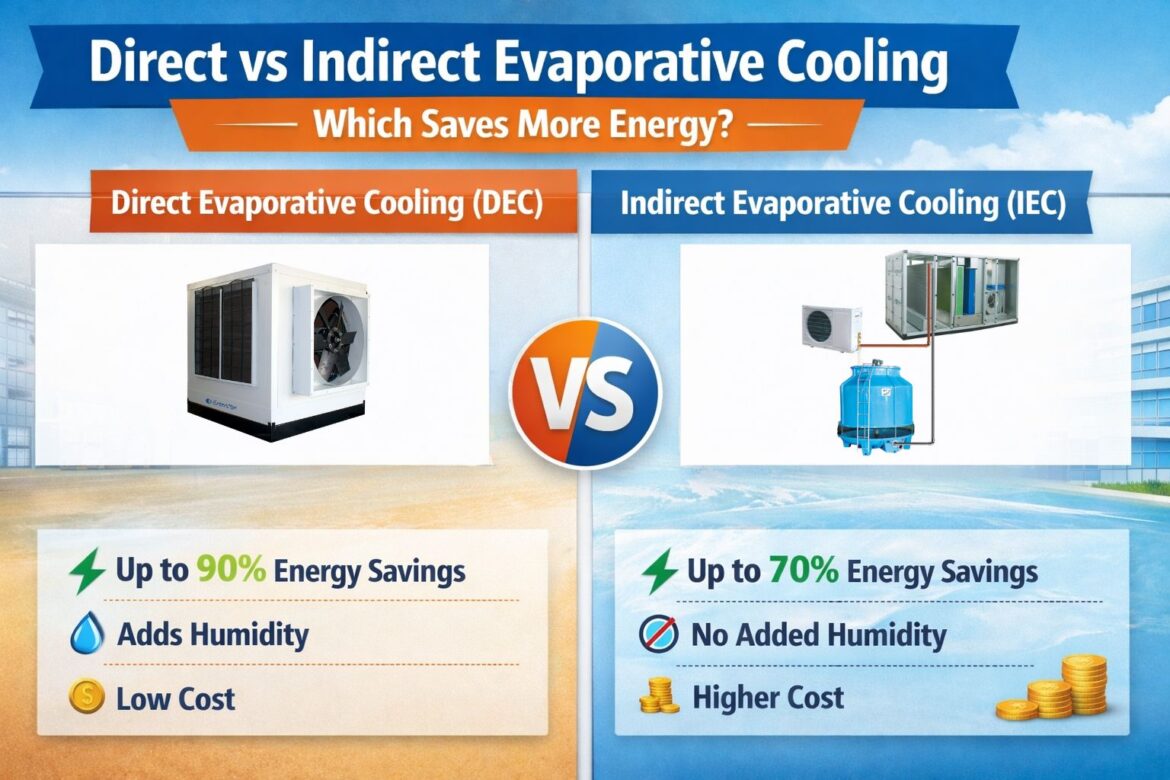
Direct evaporative cooling can reduce electricity consumption by up to 80–90% compared to conventional air conditioning systems.

👉 Related reading: Is Evaporative Cooling Eco-Friendly?

What Is Indirect Evaporative Cooling (IEC)?

Indirect Evaporative Cooling cools air without adding moisture. It uses a heat exchanger, where evaporation occurs in a separate air stream that cools the supply air indirectly.

How Indirect Evaporative Cooling Works

● Outdoor air is cooled through evaporation in a secondary channel
● Heat is transferred via a heat exchanger
● Supply air temperature drops without absorbing moisture
● Cool, dry air is delivered indoors

Key Benefits of Indirect Evaporative Cooling

● No increase in indoor humidity
● Higher comfort in mixed or humid climates
● Ideal for temperature-sensitive environments
● Can be integrated with hybrid HVAC systems

Energy Savings with IEC

Indirect evaporative cooling systems typically reduce energy consumption by 60–70% compared to traditional air conditioning.

👉 Related reading:
How HVAC Systems Work in Commercial Buildings

ParameterDirect Evaporative CoolingIndirect Evaporative Cooling
Energy savings⭐⭐⭐⭐⭐ (Highest)⭐⭐⭐⭐
Humidity controlAdds humidityNo added humidity
Initial investmentLowerHigher
Climate suitabilityHot & dry regionsMixed & humid climates
Fresh air100% fresh air100% fresh air
Comfort levelModerateHigh

Which Evaporative Cooling System Saves More Energy?

If maximum energy savings is the only criterion, Direct Evaporative Cooling is the clear winner. Its minimal power consumption and high airflow make it ideal for large, open spaces.

However, in applications where humidity control and thermal comfort are equally important, Indirect Evaporative Cooling provides a better balance between efficiency and comfort.

When Should You Choose Direct Evaporative Cooling?

Choose DEC if you need:

● Maximum electricity savings
● High fresh-air ventilation
● Cooling for open or semi-open areas
● Industrial or commercial cooling for large spaces
● Lower upfront cost

Best suited for: Warehouses, factories, workshops, farms, logistics centers, commercial areas, villas, and rooftops

👉 Learn more: Best HVAC Solutions for Warehouses & Factories & Evaporative Cooling Systems

When Should You Choose Indirect Evaporative Cooling?

Choose IEC if you need:

● Cooling without increasing humidity
● Higher comfort for enclosed spaces
● Energy-efficient alternative to air conditioning
● Temperature-controlled environments

Best suited for: Offices, IT parks, malls, data centers, hospitals, laboratories, clean rooms

👉 Useful links: Clean Room HVAC Solutions

Hybrid Cooling Systems: The Most Energy-Efficient Approach

Modern HVAC systems increasingly combine Indirect + Direct Evaporative Cooling or Evaporative Cooling + Air Conditioning.

Why Hybrid Cooling Works

➠ Reduces AC load by 40–60%
➠ Improves comfort and humidity control
➠ Enhances overall system efficiency
➠ Ideal for large commercial and industrial facilities

Why Choose Degree Day Pvt. Ltd.?

With 26 years of HVAC expertise, Degree Day Pvt. Ltd. designs and delivers custom evaporative and hybrid cooling solutions tailored to Indian climate conditions.

We offer:

➤ End-to-end HVAC EPC services
➤ Energy-efficient evaporative cooling systems
➤ HVAC design, installation & maintenance
➤ Proven experience across industrial & commercial projects
Air Purifiers and Designer Bladeless Fans

FAQs Related to Direct vs Indirect Evaporative Cooling

1. Which evaporative cooling system saves the most energy?

Direct Evaporative Cooling saves the most energy, offering up to 90% power savings compared to air conditioning.

2. Does evaporative cooling work in humid climates?

Indirect evaporative cooling and hybrid systems work better in humid or mixed climates.

3. Is evaporative cooling suitable for factories and warehouses?

Yes, direct evaporative cooling is ideal for large industrial spaces with high ventilation requirements.

4. Can evaporative cooling replace air conditioning?

In many applications, yes. In others, a hybrid system delivers the best performance.

5. Does Degree Day provide customized HVAC solutions?

Absolutely. Degree Day offers tailor-made HVAC designs based on climate, space, and energy goals.
Direct Evaporative Cooling → Maximum energy savings
✔ Indirect Evaporative Cooling → Better comfort & humidity control
Hybrid Systems → Best overall efficiency

Need expert guidance? Send an enquiry to Degree Day

25Dec

HEPA Filters for Clean Rooms

by Priyanka Gupta

Maintaining ultra-clean air is not optional in controlled environments; it is essential. Clean rooms are used in industries where even microscopic contamination can lead to product failure, safety risks, or regulatory non-compliance. From pharmaceutical manufacturing to semiconductor fabrication, HEPA filters for clean rooms play a critical role in achieving and maintaining stringent air quality standards.

Why HEPA Filters Are Essential in Clean Rooms

Clean rooms are designed to control airborne particles, temperature, humidity, and pressure. Among these factors, airborne particle control is the most critical, and this is where clean room HEPA filtration systems come into play.

HEPA filters ensure that the air entering and circulating within the clean room meets strict cleanliness levels required by international standards such as ISO 14644 and GMP (Good Manufacturing Practices). Without HEPA filters, maintaining consistent air purity would be nearly impossible.

Clean Room Classifications and HEPA Filtration

Clean rooms are classified based on the number of particles allowed per cubic meter of air. Common classifications include:

ISO Class 1–3: Ultra-clean environments (microelectronics, nanotechnology)
ISO Class 4–6: Pharmaceutical production, medical device manufacturing
ISO Class 7–8: Biotechnology labs, packaging areas

Higher-class clean rooms require ceiling-mounted HEPA filters, often combined with laminar airflow systems, to deliver continuous, uniform, and contamination-free air.

HEPA Filters vs ULPA Filters in Clean Rooms

While HEPA filters are the industry standard, some clean rooms use ULPA (Ultra-Low Penetration Air) filters. The choice depends on application requirements:

HEPA Filters: Suitable for most pharmaceutical, medical, and laboratory clean rooms
ULPA Filters: Used in extremely sensitive environments like semiconductor and aerospace manufacturing

For the majority of clean room applications, HEPA filters provide the optimal balance of efficiency, airflow, and cost-effectiveness.

Installation of HEPA Filters in Clean Rooms

Proper installation is just as important as filter quality. Even a small leak around a HEPA filter can compromise the entire clean room environment. Clean room HEPA filters are typically installed in:

➢ Ceiling grid systems
➢ Fan Filter Units (FFUs)
➢ Terminal HEPA filter housings
➢ Wall-mounted return air systems

Professional installation ensures:

➢ Airtight sealing (to prevent air bypass)
➢ Uniform airflow distribution
➢ Compliance with clean room standards

Maintenance and Replacement of Clean Room HEPA Filters

Well-maintained HEPA filters help extend HVAC system life and ensure uninterrupted clean room operation. Regular maintenance is essential to ensure long-term performance. Over time, HEPA filters accumulate particles, increasing air resistance and reducing airflow.

Key Maintenance Practices:

➢ Routine pressure drop monitoring
➢ Scheduled airflow testing
➢ Integrity testing (DOP/PAO testing)
➢ Timely replacement based on usage and environment

Industries That Rely on HEPA Filters for Clean Rooms

➢ Pharmaceutical & Biotechnology
➢ Medical Device Manufacturing
➢ Semiconductor & Electronics
➢ Food & Beverage Processing
➢ Aerospace & Defense

Regulatory Compliance and Certifications

Clean room HEPA filters must comply with recognized standards, including:

➢ ISO 14644 Clean Room Standards
➢ EN 1822 HEPA Filter Testing
➢ GMP and FDA Guidelines
➢ ASHRAE Recommendations

Using certified HEPA filters ensures regulatory approval, audit readiness, and consistent product quality.

Cost Considerations and Long-Term Value

Investing in high-quality HEPA filtration is a cost-effective decision for any clean room facility. While clean room HEPA filters may appear expensive initially, they offer long-term value by:

➢ Reducing product rejection rates
➢ Minimizing downtime
➢ Preventing regulatory penalties
➢ Improving operational efficiency

Degree Day Private Limited – Your Clean Room Air Purification Partner

Degree Day Private Limited is a trusted provider of clean room HVAC systems, HEPA filters, and complete air purification solutions. With expertise in clean room design, engineering, installation, and maintenance, Degree Day delivers turnkey solutions tailored to industry-specific requirements.

Why Choose Degree Day?

➢ End-to-end clean room solutions
➢ High-quality HEPA filtration systems
➢ Compliance with ISO, GMP, and industry standards
➢ Experienced engineering and project execution teams
➢ Reliable after-sales support and maintenance services

Degree Day’s solutions are designed to ensure long-term performance, regulatory compliance, and operational efficiency.

FAQs Related to Clean Room & Air Purification

1. How often should HEPA filters be replaced in clean rooms?

Replacement typically occurs every 2–5 years, depending on usage, airflow load, and the level of contamination.

2. Where can I get certified HEPA filter-equipped air purifiers in India?

You can get certified HEPA filter-equipped air purifiers from Degree Day Pvt. Ltd. under its premium air purification brand HEPairé, which is available in three models: Aura, Pura, and Astria.

3. Can clean rooms operate without HEPA filters?

No. HEPA filters are essential to meet clean room air cleanliness standards.

4. Are HEPA filters tested after installation?

Yes. Integrity testing, such as PAO or DOP testing, is mandatory after installation.

5. Do HEPA filters affect clean room airflow?

Properly selected HEPA filters ensure optimal airflow while maintaining filtration efficiency.

6. Are all HEPA filters suitable for clean rooms?

No. Only certified clean room HEPA filters designed for controlled environments should be used.

26Nov

Which HVAC System Suits Your Industry? A Complete Guide for Every Sector

by Priyanka Gupta

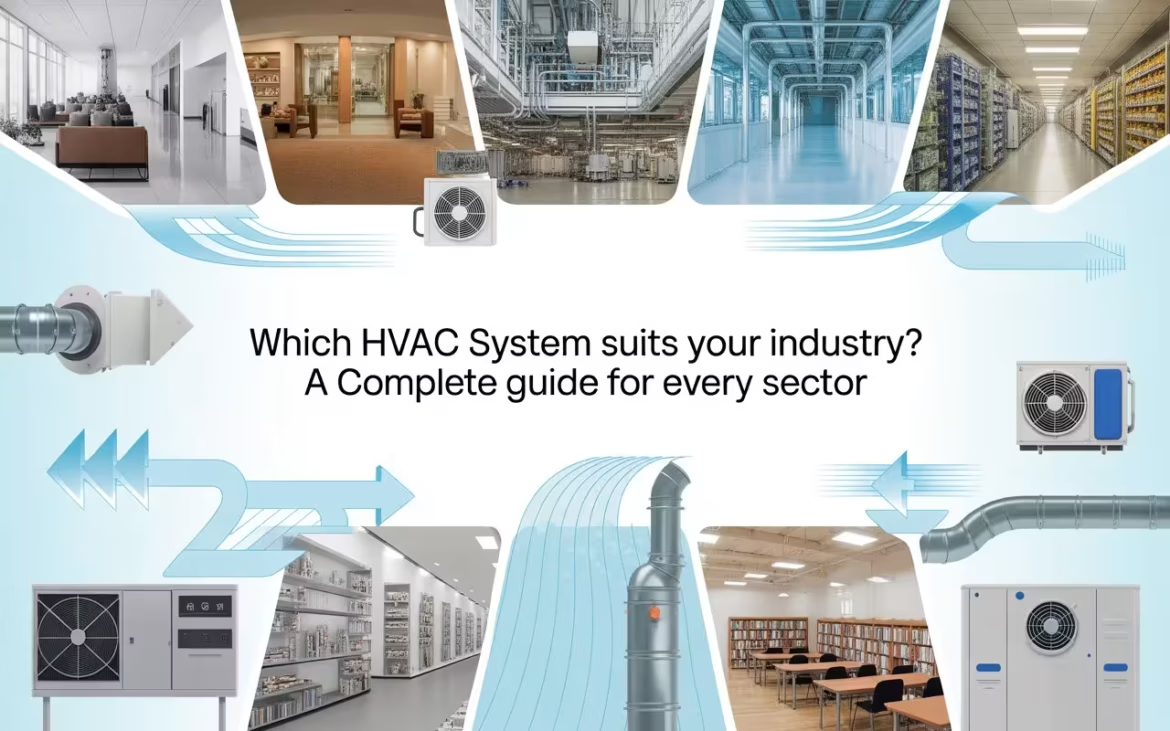
Every industry has its own cooling, ventilation, and air-quality needs. Choosing the right HVAC system is not just about comfort; it is about safety, efficiency, and meeting compliance standards. This guide breaks down the most important sectors, Hospitality, Industrial, Pharmaceutical, Commercial, Retail, Healthcare, Religious, and Institutional buildings, so you can easily identify the HVAC solution that fits your environment.

Request a Free HVAC Consultation

Hospitality Sector – Hotels, Restaurants & Banquet Halls

In the hospitality business, guest comfort is everything. Whether it is a hotel lobby, a restaurant dining area, or a packed banquet hall, the HVAC system sets the tone for the entire experience. A well-designed system ensures ideal temperatures, consistent fresh air, and effective odor control, which is significant in kitchens and food service areas. For events and large gatherings, HVAC keeps the atmosphere pleasant from start to finish.

Best HVAC Options

1. Evaporative Cooling Systems
2. VRF/VRV Systems
3. Chillers + AHUs
4. Kitchen Exhaust & Hood Systems

Industrial Sector – Manufacturing Plants & Factories

Factories and manufacturing units rely on HVAC to create a safe and controlled working environment. These systems help manage temperature, humidity, and ventilation while reducing dust, fumes, and harmful pollutants. Aside from protecting workers, HVAC prevents machinery from overheating and helps maintain product quality. Efficient air systems also support compliance with industrial safety norms.

Best HVAC Options

1. Evaporative / Central Air Cooling
2. Industrial Ventilation Systems
3. Dust Extraction & Fume Exhaust
4. HVLS Fans
5. Spot Cooling Systems

Pharmaceutical Sector – Cleanrooms & Production Areas

The pharmaceutical industry demands absolute precision in air quality. Cleanrooms rely on strict control over temperature, humidity, and airborne particles to prevent contamination. A robust HVAC system ensures sterile conditions, protects sensitive products, and helps companies meet regulatory standards. It also creates a safer environment for the workforce involved in manufacturing critical medicines.

Best HVAC Options

1. Cleanroom HVAC (Class 100 to 10,000)
2. HEPA 13 / HEPA 14 Filtration
3. Dehumidification Units
4. Chillers + AHUs with VFD Control

Commercial Sector – Offices, Corporate Buildings & IT Parks

Comfortable workspaces lead to better productivity. In offices and corporate IT hubs, HVAC systems maintain optimal temperatures, steady airflow, and fresh indoor air and all of which help employees stay focused and healthy. These systems also reduce noise, manage odors, and support energy-saving strategies across large, multi-zone buildings.

Best HVAC Options

1. Evaporative / Central Air Cooling
2. VRF / VRV Systems
3. Chiller + AHU Systems (ideal for large campuses)
4. Demand-Control Ventilation (DCV)

Retail Sector – Shops & Showrooms

The retail environment depends heavily on customer comfort. A well-balanced HVAC system keeps the store cool, fresh, and inviting while protecting products from humidity and temperature fluctuations. Shoppers tend to stay longer in comfortable spaces, which often translates to better sales and a stronger brand impression.

Best HVAC Options

1. Evaporative / Central Air Cooling
2. VRF Systems – Great for medium to large showrooms
3. Ductable ACs – Best for single-level shops
4. Chillers + AHUs – Ideal for malls
5. Air Curtains – Effective for high-traffic entrances

Hospitals & Healthcare Facilities

Healthcare facilities need precise climate control to protect patients and reduce infection risks. HVAC plays a major role in maintaining sterile conditions in critical areas like OTs and ICUs. It regulates temperature, humidity, and ventilation while filtering out harmful microorganisms. These systems support patient recovery, ensure staff comfort, and help hospitals meet stringent healthcare guidelines.

Best HVAC Options

1. Chiller + AHU Systems with HEPA
2. UVGI Air Disinfection
3. Laminar Flow for Operation Theatres
4. Dedicated Fresh Air Systems (DOAS)
5. Air Purifiers for OPDs & Waiting Areas

Religious Spaces – Temples, Mosques, Churches & Prayer Halls

Large gatherings in religious spaces require reliable ventilation and cooling. HVAC systems help maintain a peaceful, comfortable environment for worshippers by controlling temperature, humidity, and fresh airflow. They also help eliminate odors and ensure proper air circulation even during peak crowd hours, making the spiritual experience pleasant and distraction-free.

Best HVAC Options

1. VRF Systems
2. Ductable AC Systems
3. Evaporative Cooling
4. Air Curtains for Entrances

Institutional Buildings – Schools, Colleges & Training Centers

In learning environments, comfort directly affects focus and performance. HVAC systems in schools and training institutes ensure classrooms remain cool, well-ventilated, and hygienic. Proper air circulation minimizes allergens and dust, helping students stay healthier and more attentive throughout the day.

Best HVAC Options

1. VRF / VRV Systems
2. Evaporative Cooling
3. Fresh Air Ventilation Systems
4. Ductable ACs for auditoriums

Request a Free HVAC Consultation


Contact Degree Day – Your Complete HVAC Solution Partner

Looking for expert guidance or a complete end-to-end HVAC solution? Degree Day is here to help.

We offer:
HVAC Design Services
HVAC Project Execution Services
Turnkey HVAC Solutions

Our Product Range Includes: Know More

  • Evaporative Air Coolers (Residential, Commercial & Industrial)
  • Bladeless Fans (Three Variants)
  • Spiral, Oval & Rectangle Ducts
  • Air Handling Units
  • Exhaust Fans
  • Mist Cooling Systems

Every industry has different challenges, whether it is crowd density, equipment heat load, hygiene requirements, or energy usage. The right HVAC system can transform your space by improving comfort, safety, and operational efficiency. Use this guide as a starting point to identify what works best for your environment and budget.

Request a Free HVAC Consultation

Get in Touch

Please share your details below and we’ll get back to you soon.

11Nov

Best HVAC Company in Lucknow

by Priyanka Gupta

Lucknow has always been a city of balance, a blend of tradition and progress, of history and innovation. As the skyline continues to rise and new businesses establish themselves across the city, one thing has become clear: comfort and air quality are no longer luxuries, but essentials.

That’s where Degree Day steps in. With over 25 years of experience and ISO 9001:2015 certification, Degree Day has established itself as a trusted name in the world of HVAC design, manufacturing, and turnkey solutions across North India. Whether it’s a hospital requiring precision air control or a commercial complex demanding energy efficiency, the company has earned a reputation for delivering results that last.

Need Advice?Want Product Catalogues?


More Than Just Air Conditioning: A Complete HVAC Experience

When people hear “HVAC,” they often think of cooling or heating systems. But true comfort goes beyond temperature. It’s about air quality, circulation, humidity, and even energy management.

Degree Day specializes in turnkey HVAC solutions, which means we handle every aspect of your project from the first consultation to the final commissioning. You don’t have to coordinate with multiple vendors or stress about technical details. Our experts take care of everything:

1. Site Evaluation: Understanding Your Space, Requirements, and Energy Needs.
2. System Design: Creating tailored solutions that perfectly fit your environment.
3. Installation: Flawless execution with safety and efficiency in mind.
4. Maintenance & Support: Routine inspections and reliable after-sales service to keep systems performing at their best.

It’s a smooth, worry-free experience, the way professional climate control should be.

Why Businesses Across Lucknow Trust Degree Day

Over the years, Degree Day has earned a reputation for precision, reliability, and genuine trust. Our journey has taken us across a wide range of industries, from advanced cleanrooms and large-scale manufacturing facilities to hospitals, retail spaces, and modern corporate offices.

In Lucknow and throughout Uttar Pradesh, we offer comprehensive HVAC solutions tailored to every type of space, including basement ventilation, cleanroom environments, hospitality setups, showrooms, residential complexes, commercial buildings, and full-scale industrial projects. Whatever the need, our focus remains the same: delivering comfort, efficiency, and performance that lasts.

Here’s what sets them apart:

1. Decades of Experience: With 25+ years in the HVAC industry, their team understands every technical and environmental challenge Lucknow presents.
2. Quality Without Compromise: All projects adhere to global standards, including ISHRAE and ASHRAE guidelines.
3. Energy Efficiency First: Their systems are designed to reduce energy costs while maintaining superior performance.
4. Customized Designs: Every project is unique, and so is every Degree Day solution.
5. Transparent Pricing: No hidden costs, no surprises, just honest, value-driven service.

From design to execution, Degree Day ensures that every system not only performs but also endures.

Trusted by India’s Leading Brands

Degree Day’s portfolio in Lucknow speaks volumes. Some of the region’s most respected names rely on our HVAC systems for efficient and reliable operations, a true mark of trust and capability.

Our Clients in Lucknow Include:
Kanpur Plastic, Viraj Constructions, Birla Dharamshala (Ayodhya), Lete Hue Hanuman Mandir, Safety Shoes Manufacturing Unit, Ex-CM Residence, Delhivery Warehouse (Lucknow), Ford Car Showroom, and many more.

Smart, Sustainable, and Ready for the Future

In today’s world, efficiency and sustainability go hand in hand. Degree Day integrates smart automation and eco-friendly HVAC technologies to help clients cut energy use without compromising comfort.

Our products & Services include centralized air conditioning, UVGI-based air purification, prefabricated ducts, Mist Cooling System, Bladeless Fans, Exhaust Fans, Basement Ventilation, HVAC Design, HVAC Projects, Clean Room Solution, HEPA Air Purifiers, Air Washer, Air Handling Units, Single, Dual and Hybrid Evaporative Cooling System, and smart energy control, all engineered to ensure clean, safe, and sustainable indoor environments.

Whether it’s a high-end commercial space or an industrial setup, Degree Day’s team ensures the perfect balance between technology, performance, and environmental responsibility.

Why Local Expertise Matters

Lucknow’s climate can be unpredictable sweltering summers, humid monsoons, and chilly winters. Generic systems simply don’t cut it here. Our deep understanding of local weather patterns and building needs means their solutions are built for real conditions, not assumptions.

We don’t just install machines; we design environments where people can work, heal, and live comfortably all year round.

Building Better Air, Together

Comfort isn’t just about cooling a room; it’s about creating spaces that help people feel better, work smarter, and breathe easier. That philosophy drives everything Degree Day does.

Whether you’re planning a new project or upgrading an existing system, Degree Day is ready to design, deliver, and maintain an HVAC solution that aligns with your vision and budget.

Quick Highlights

● 25+ years of HVAC expertise
● ISO 9001:2015 Certified
● Turnkey project design & execution
● Energy-efficient and eco-friendly systems
● Trusted by India’s leading brands

Frequently Asked Questions

1. What makes Degree Day the best HVAC company in Lucknow?

With 25+ years of experience and ISO 9001:2015 certification, Degree Day delivers reliable, high-performance HVAC systems. From design to maintenance, every project is tailored for efficiency, durability, and Lucknow’s unique climate.

2. What types of HVAC solutions does Degree Day offer?

They offer complete HVAC solutions – centralized AC, air purification (UVGI + HEPA), prefabricated ducts, air washers, evaporative air coolers, air purifiers, cleanroom systems, ventilation setups, and hybrid cooling for homes, offices, and industries.

3. Does Degree Day handle end-to-end HVAC projects?

Yes. Degree Day manages turnkey projects from site evaluation and design to installation, commissioning, and maintenance—ensuring a smooth, worry-free process.

4. Why is local HVAC expertise important for Lucknow projects?

Lucknow’s hot, humid climate needs specialized systems. Degree Day’s local experience ensures efficient, weather-optimized solutions that perform year-round.

5. Which leading clients trust Degree Day’s HVAC solutions in Lucknow?

Trusted by brands like Kanpur Plastic, Viraj Constructions, Birla Dharamshala (Ayodhya), Lete Hue Hanuman Mandir, and Ford Showroom, among others.

Get in Touch

Please share your details below and we’ll get back to you soon.