LOADING...

Category "HVAC"

19Mar

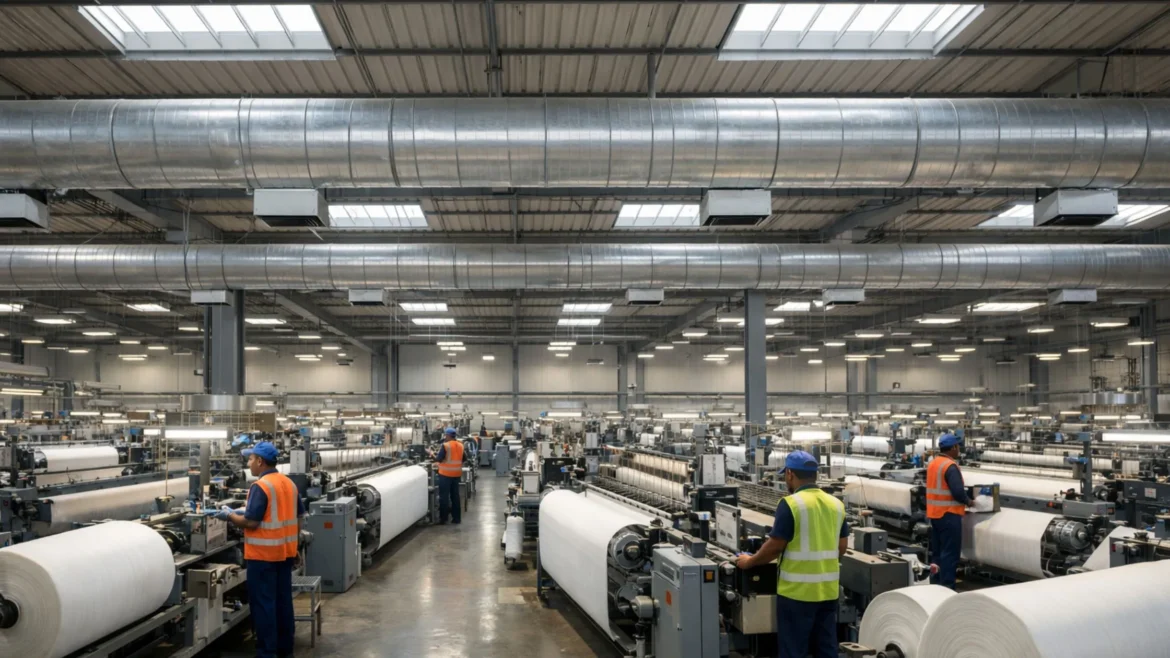
Cooling Solutions for the Textile Industry

by Priyanka Gupta

The best cooling solution for the textile industry in India depends on factors such as plant size, machine heat load, humidity requirements, and energy costs. However, most modern textile mills prefer evaporative cooling with proper ventilation and humidity control because it is energy-efficient, cost-effective, and suitable for large factory spaces.

Below are the most effective cooling solutions used in textile factories.

1. Industrial Evaporative Air Cooling (Most Popular)

This is the most widely used cooling system in textile factories because textile plants are large and require fresh air circulation.

How it works: Hot outside air passes through water-soaked cooling pads, which cool the air before it enters the factory through ducts.

Benefits

➠ Reduces temperature by 5–12°C in large facilities
➠ Up to 80% lower energy consumption compared to conventional AC
➠ Provides 100% fresh air ventilation
➠ Helps maintain humidity levels important for yarn quality
➠ Ideal for spinning, weaving, and garment units

Best for

➠ Spinning mills
➠ Weaving units
➠ Garment manufacturing floors
➠ Large textile production halls

2. Indirect-Direct Evaporative Cooling (IDEC)

A more advanced version of evaporative cooling is used in modern textile plants.

Key advantages

➠ 40–50% energy savings vs traditional cooling systems
➠ Cool air without excessive humidity
➠ More stable temperature control

Best for

➠ Automated textile plants
➠ Sensitive yarn processing environments
➠ High-efficiency factories

3. Humidification + Cooling Systems

Textile production requires controlled humidity, not just cooling.

Why humidity matters

Correct humidity:

➠ Reduces yarn breakage
➠ Prevents static electricity
➠ Improves weaving efficiency

Typical systems:

Air washer systems
➠ Humidification plants
➠ Mist cooling systems

4. Industrial Mist Cooling Systems

Used in specific zones, such as dyeing or high-heat areas.

Benefits

➠ Reduces heat near machines
➠ Controls dust and lint
➠ Improves worker comfort and productivity

5. Central HVAC

Traditional chilled-water HVAC is rarely used for full textile factories because:

➠ Very high energy consumption
➠ Expensive installation and maintenance
➠ Better suited for cleanrooms or small textile labs

Recommended Cooling Setup for a Textile Factory

Most efficient configuration: Industrial Evaporative Coolers + Ducting + Exhaust Ventilation

Typical system design:

✱ Roof-mounted air coolers
Prefabricated duct network
✱ Fresh air supply
Exhaust fans for hot air removal

This setup:

✱ Maintains 28–32°C working temperature
✱ Improves worker productivity
✱ Reduces electricity costs.

FAQ – Textile Industry Cooling Solutions

1. What is the best cooling solution for textile factories in India?

The most effective cooling solution for textile factories is industrial evaporative air cooling combined with proper ventilation and humidity control. This system is energy-efficient, provides fresh air circulation, and works well in large textile production areas such as spinning, weaving, and garment manufacturing units.

2. Why is evaporative cooling preferred in textile mills?

Evaporative cooling is preferred because it:
✧ Consumes up to 80% less energy than traditional air conditioning
✧ Provides 100% fresh air ventilation
✧ Works efficiently in large open factory spaces
✧ Helps maintain optimal humidity levels for yarn quality

3. What temperature should be maintained inside a textile factory?

Most textile factories aim to maintain a working temperature between 28°C and 32°C. This range helps improve worker comfort while maintaining stable yarn and fabric production conditions.

4. What airflow capacity is required for textile factory cooling?

Textile factories typically use industrial air coolers with airflow ranging from 10,000 to 40,000 CFM, depending on the size of the production hall and the heat generated by machines.

5. What is the difference between direct evaporative cooling and IDEC cooling?

Direct evaporative cooling cools air by passing it through water-soaked cooling pads, while Indirect-Direct Evaporative Cooling (IDEC) first cools air indirectly before adding evaporative cooling. IDEC systems provide better temperature control and lower humidity levels.

6. Can mist cooling systems be used in textile plants?

Yes, mist cooling systems can be used in specific zones of textile factories, especially near high-heat machines or dyeing sections. They help reduce localized heat and improve worker comfort.

Get a Free Cooling Solution Consultation

    Get in Touch

    Please share your details below and we’ll get back to you soon.

    9Mar

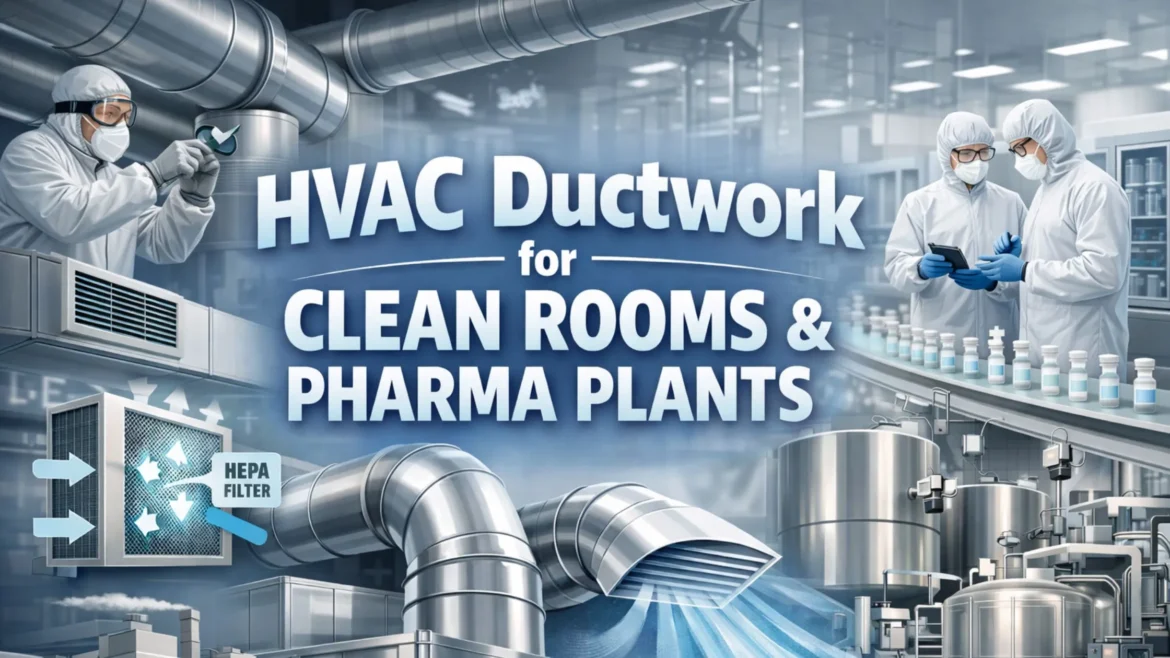
    HVAC Ductwork for Clean Rooms & Pharma Plants

    by Priyanka Gupta

    Design, Materials, Compliance & Contamination Control

    In pharmaceutical manufacturing and cleanroom environments, HVAC ductwork is more than just an air distribution system; it is a critical contamination-control component. Unlike conventional HVAC systems designed for comfort, cleanroom ductwork is engineered to maintain air purity, pressure differentials, and regulatory compliance in accordance with ISO 14644 and GMP guidelines.

    This guide explains how HVAC ductwork in clean rooms and pharma plants differs, what materials are used, and how proper design ensures product safety.

    1. Why HVAC Ductwork is Critical in Pharma Plants

    In pharmaceutical facilities, air is part of the manufacturing process. Improper duct design can lead to:

    1. Cross-contamination
    2. Pressure imbalance
    3. Particle accumulation
    4. Regulatory non-compliance
    5. Failed validation audits

    Therefore, ductwork must support:

    1. Controlled airflow patterns
    2. HEPA-filtered air distribution
    3. Strict leakage standards
    4. Pressure cascade systems
    5. Easy cleaning and maintenance

    2. Key Design Considerations for Cleanroom Ductwork

    1. Low Leakage Construction

    Cleanroom ducts are fabricated to high sealing classes, often aligned with guidelines from SMACNA. Even minor air leakage can disturb pressure differentials between critical zones.

    ✔ Continuous sealing of joints
    ✔ Minimal flange connections
    ✔ Proper gasket selection
    ✔ Leak testing before commissioning

    2. Air Changes Per Hour (ACH)

    Cleanrooms require specific ACH depending on ISO classification:

    ✔ Grade A / ISO 5 → Very high ACH
    ✔ Grade B, C, D → Moderate to high ACH

    Proper duct sizing ensures uniform airflow without turbulence.

    3. Pressure Cascade Control

    Pharmaceutical HVAC systems maintain controlled pressure differences:

    ✔ Positive pressure → Sterile manufacturing areas
    ✔ Negative pressure → Containment and hazardous zones

    Ducting layout must support these cascades without imbalance.

    3. Material Selection for Pharma HVAC Ductwork

    Stainless Steel (SS 304 / SS 316)

    Used in critical and sterile zones due to:

    ✔ Corrosion resistance
    ✔ Smooth internal surface
    ✔ Compatibility with chemical cleaning

    SS 316 is preferred where aggressive disinfectants are used.

    High-Seal Galvanized Iron (GI)

    ✔ Used in non-critical areas when:
    ✔ Proper sealing is ensured
    ✔ Internal insulation is avoided
    ✔ Surface finish is smooth and cleanable

    Pre-Insulated Duct Panels (PIR/PUF)

    ✔ Lightweight and energy efficient
    ✔ Reduced condensation risk
    ✔ Faster installation

    Must be closed-cell and fiber-free inside the air stream.

    4. Filtration Integration

    Cleanroom HVAC ductwork works in coordination with:

    1. Pre-filters
    2. Fine filters
    3. HEPA filters (99.97% efficiency at 0.3 micron)
    4. ULPA filters (ultra-critical areas)

    Terminal HEPA housing systems are airtight and gasket-sealed to prevent bypass leakage.

    5. Airflow Patterns & Contamination Control

    Two main airflow types are used:

    Unidirectional (Laminar) Airflow

    ✔ Used in sterile zones (Grade A)
    ✔ Sweeps particles away from critical processes

    Non-Unidirectional Airflow

    ✔ Used in Grade B, C, and D areas
    ✔ Maintains dilution-based contamination control

    CFD analysis is often conducted to validate airflow performance before installation.

    6. Compliance & Validation Requirements

    Pharma ductwork systems must support:

    1. Leakage testing
    2. Air velocity measurement
    3. Particle count validation
    4. Differential pressure monitoring
    5. IQ/OQ/PQ documentation

    Regulatory bodies such as the WHO, EU GMP, and the US FDA expect documented HVAC validation during audits.

    7. Common Mistakes to Avoid

    1. Using internal fibrous insulation
    2. Ignoring pressure balance during duct routing
    3. Poorly sealed access doors
    4. Improper return air placement
    5. Skipping pre-commissioning leak testing

    These errors can compromise contamination control.

    8. Benefits of Properly Designed Cleanroom Ductwork

    ✔ Enhanced product safety
    ✔ Stable pressure control
    ✔ Reduced contamination risk
    ✔ Lower audit risk
    ✔ Improved energy efficiency
    ✔ Long-term operational reliability

    HVAC ductwork for clean rooms and pharmaceutical plants is a precision-engineered system designed to control airflow, contamination, and compliance, not just temperature.

    By selecting the right materials, maintaining low leakage standards, integrating HEPA filtration, and validating airflow performance, pharma facilities can ensure regulatory compliance and product integrity.

    Looking for Expert Cleanroom HVAC Duct Solutions?

    If you are planning a pharmaceutical plant, sterile facility, or ISO-classified cleanroom, consult an experienced HVAC duct manufacturer who understands GMP compliance, airflow design, and contamination control.

    Proper ductwork isn’t just infrastructure; it’s quality assurance in motion.

    Frequently Asked Questions (FAQs)

    Q. What makes HVAC ductwork in clean rooms different from normal HVAC ducting?

    Cleanroom HVAC ductwork is designed for contamination control, pressure regulation, and regulatory compliance, not just temperature control. It must meet standards such as ISO 14644 and follow GMP guidelines. These ducts have stricter leakage control, smoother internal surfaces, and integration with HEPA filtration systems.

    Q. Which material is best for HVAC ductwork in pharmaceutical plants?

    For critical sterile areas, Stainless Steel (SS 304 or SS 316) is preferred due to corrosion resistance and cleanability. In non-critical zones, high-seal Galvanized Iron (GI) ducts may be used if fabricated according to guidelines from SMACNA and properly sealed.

    Q. Why is leakage control important in cleanroom duct systems?

    Even minor air leakage can disturb pressure differentials between rooms, leading to cross-contamination. Cleanroom ducts are fabricated to high sealing classes and undergo leakage testing to maintain proper pressure cascades and ISO classification.

    Q. How many air changes per hour (ACH) are required in pharmaceutical cleanrooms?

    ACH requirements depend on the cleanroom grade:
    + ISO 5 / Grade A → Very high ACH
    + Grade B, C, D → Moderate to high ACH
    Proper ACH ensures particle dilution and contamination control while maintaining compliance.

    Q. Do pharmaceutical HVAC duct systems require validation?

    Yes. Pharma HVAC systems must undergo testing and documentation, including leakage tests, airflow balancing, particle count verification, and IQ/OQ/PQ validation. Regulatory authorities such as the WHO, EU GMP, and the US FDA require documented HVAC performance during audits.

    26Feb

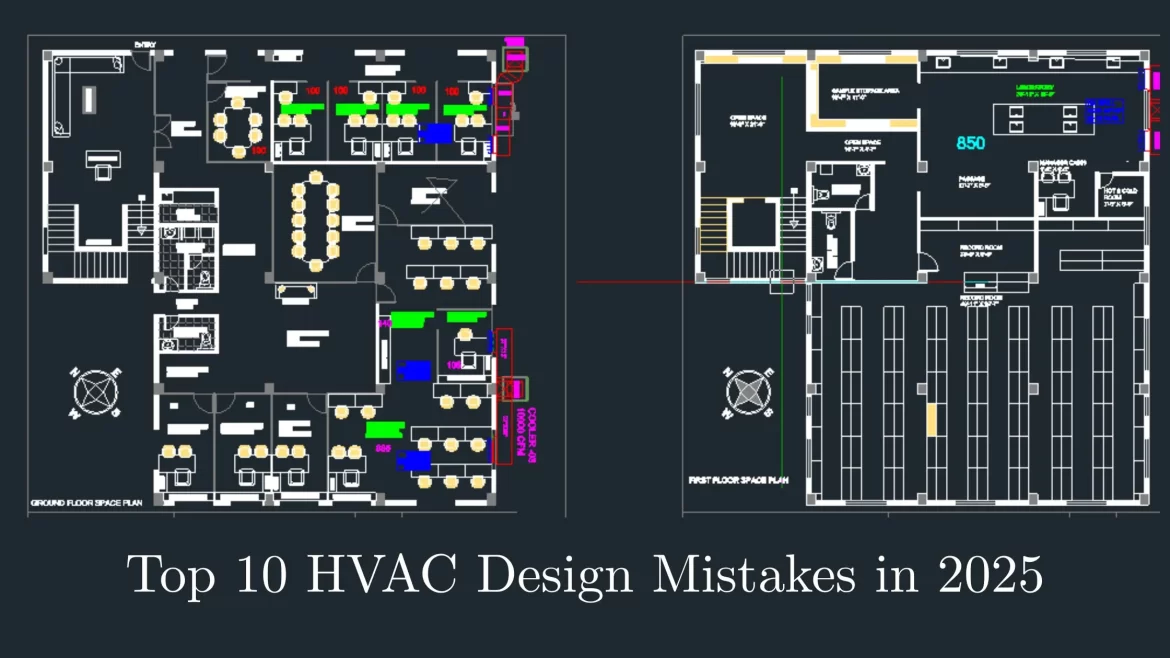
    Top HVAC Design Mistakes in Industrial & Commercial Projects (2026) – And How to Avoid Them

    by Priyanka Gupta

    As buildings across India become smarter, energy codes get stricter, and operational costs rise, HVAC design is no longer just about cooling, it’s about efficiency, compliance, and long-term performance.

    In industrial facilities, hospitals, and commercial buildings, even small HVAC design mistakes can lead to:

    ✔ High energy bills
    ✔ Poor cooling performance
    ✔ Frequent breakdowns
    ✔ Compliance issues

    This guide highlights the Top HVAC Design Mistakes in 2026, specifically for industrial and commercial HVAC systems, along with best practices used by leading HVAC solution providers in India.

    1. Incorrect HVAC Load Calculation

    One of the most critical mistakes in HVAC system design is relying on assumptions instead of proper heat load calculations.

    Why it matters:

    ✔ Oversized systems → Higher electricity bills + humidity issues
    ✔ Undersized systems → Poor cooling + system failure

    Best Practice:

    Use advanced HVAC load calculation software, considering:

    ✔ Building orientation
    ✔ Occupancy levels
    ✔ Heat-generating equipment
    ✔ Indian climate conditions

    2. Poor Duct Design & Airflow Planning

    Even the best HVAC equipment fails with badly designed duct systems.

    Common issues:

    ✔ Improper duct sizing
    ✔ Air leakage
    ✔ High static pressure
    ✔ Uneven airflow

    Best Practice:

    ■ Use precision-engineered ducting systems
    ■ Follow airflow balancing standards
    ■ Optimize layout for factories & large spaces

    3. Ignoring Indoor Air Quality (IAQ)

    In 2026, HVAC is not just cooling—it’s air purification + ventilation.

    Risks:

    ✔ Poor employee health
    ✔ Non-compliance in hospitals & pharma units
    ✔ Reduced productivity

    Best Practice:

    ■ Install HEPA filtration systems
    ■ Use fresh air ventilation systems
    ■ Integrate UVGI air purification

    4. Wrong Placement of Sensors & Controls

    Improper thermostat or sensor placement leads to:

    ✔ Uneven cooling
    ✔ Energy wastage
    ✔ System inefficiency

    Best Practice:

    ■ Centralized sensor placement
    ■ Zoning systems for large buildings
    ■ Smart HVAC automation

    5. Skipping HVAC Commissioning

    Many projects fail not in design, but in execution.

    Without commissioning:

    ✔ Air imbalance
    ✔ Performance issues
    ✔ Hidden system faults

    Best Practice:

    ■ Complete airflow testing
    ■ System balancing
    ■ Performance validation

    6. Lack of Coordination with Other Services

    In commercial projects, HVAC must align with:

    ✔ Electrical systems
    ✔ Fire safety
    ✔ Architecture

    Problem:

    Clashes lead to costly redesigns and delays.

    Best Practice:

    ■ Use BIM-based HVAC design
    ■ Conduct coordination meetings

    7. Using Outdated or Inefficient Equipment

    Choosing low-cost equipment often results in:

    ✔ Higher lifecycle cost
    ✔ Increased energy consumption

    Best Practice:

    ■ Use energy-efficient HVAC systems
    ■ Prefer inverter-based & EC fan technology
    ■ Ensure compliance with Indian energy standards

    8. Ignoring Static Pressure in HVAC Design

    Improper static pressure leads to:

    ✔ Poor airflow
    ✔ Noise issues
    ✔ Reduced equipment life

    Best Practice:

    ■ Optimize duct layout
    ■ Select the correct fan systems
    ■ Measure and balance pressure

    9. No Focus on Sustainability & Energy Saving

    With rising energy costs in India, inefficient HVAC systems are a major expense.

    Mistake:

    Ignoring:

    ✔ Renewable integration
    ✔ Low-energy cooling systems
    ✔ Sustainable HVAC design

    Best Practice:

    ■ Use evaporative air cooling systems
    ■ Integrate solar-assisted HVAC
    ■ Choose eco-friendly refrigerants

    10. Poor Documentation & No Training

    Even a perfect HVAC system fails without proper handling.

    Issues:

    ✔ Maintenance errors
    ✔ Dependency on service teams
    ✔ System misuse

    Best Practice:

    ■ Provide training to operators
    ■ Deliver digital manuals
    ■ Ensure proper handover

    Best HVAC Design Practices for Industrial & Commercial Projects

    To ensure long-term performance, follow these modern HVAC best practices:

    ➣ Accurate HVAC load calculations
    ➣ High-performance ducting systems
    ➣ Advanced air purification & ventilation
    ➣ Smart controls & automation
    ➣ Proper commissioning & testing
    ➣ BIM-based coordination
    ➣ Energy-efficient equipment selection
    ➣ Optimized airflow & static pressure
    ➣ Sustainable cooling solutions
    ➣ Complete training & documentation

    HVAC Solutions for Industrial, Commercial & Healthcare Projects in India

    At Degree Day Pvt. Ltd., we specialize in industrial and commercial HVAC solutions across India, including:

    ➲ Central Air Cooling Systems (check our industrial central air cooling systems)
    ➲ Evaporative Air Cooling Solutions (check our energy-efficient evaporative air cooling)
    ➲ Industrial Ducting Systems (explore industrial ducting systems in India)
    ➲ Air Purification Systems (HEPA + UVGI) (medical-grade air purification systems)
    HVAC Design & Execution

    We deliver end-to-end HVAC solutions for:

    ➲ Factories & Warehouses
    ➲ Hospitals & Healthcare Facilities
    ➲ Commercial Buildings
    ➲ Pharma & Cleanroom Applications

    Our approach combines:

    ➲ Smart HVAC design
    ➲ Energy-efficient solutions
    ➲ On-ground execution expertise

    Looking for the Right HVAC Solution?

    Avoid costly HVAC design mistakes and ensure efficient, reliable, and future-ready cooling systems. Contact Degree Day Pvt. Ltd. today for customized HVAC design & execution services in India.

      26Feb

      Laminar Air Flow

      by Priyanka Gupta

      In industrial and commercial HVAC design, the airflow strategy has a direct impact on indoor air quality (IAQ), contamination control, and operational efficiency.

      Two primary air distribution methods dominate modern HVAC systems:

      ✔ Laminar Air Flow HVAC systems
      ✔ Turbulent Flow HVAC systems

      Understanding the difference between laminar v/s turbulent airflow in HVAC is critical when designing cleanrooms, hospitals, pharmaceutical plants, and manufacturing units.

      What is Laminar Air Flow?

      Laminar Air Flow (LAF) in HVAC refers to a unidirectional airflow system where air moves in parallel layers at a uniform velocity with minimal turbulence.

      A laminar airflow HVAC system is specifically designed to:

      ✔ Control airborne contamination
      ✔ Maintain sterile environments
      ✔ Reduce particle accumulation
      ✔ Achieve ISO cleanroom classifications

      How Laminar Airflow HVAC Works

      ✔ Air passes through HEPA filters or ULPA filters
      ✔ Filtered air flows vertically (or horizontally) in a single direction
      ✔ Constant velocity is maintained across the clean zone
      ✔ Contaminants are continuously pushed out of the critical area

      If you want a deeper understanding of HEPA filtration, read our detailed blog on HEPA Filters: What they are and How they work in air purifiers

      Applications of Laminar Air Flow HVAC Systems

      Laminar airflow systems are used in:

      ➱ Cleanrooms
      ➱ Pharmaceutical manufacturing
      ➱ Operation theatres
      ➱ Biotechnology labs
      ➱ Electronics production units

      You can explore our Cleanroom HVAC expertise here: Clean Room Solution

      Our Recent Hospitals HVAC Projects

      With extensive experience in delivering Laminar Air Flow HVAC systems for pharmaceutical environments, we have completed projects for reputed organizations including Sancheti Hospital, Gokuldas Hospital Pvt. Ltd., Greater Kailash Hospital, Narayana Hospital, M.Y. Hospital Indore, Arpit Arien Hospital, Tejankar Health Care & Medical Institute, Bombay Hospital Indore, CHL Hospital, Bhandari Hospital, Carrier Hospital, SAIMS Medical College, Dhanvantari Hospital, Khemka Hospital, Jamdar Hospital, Anand Hospital, Unique Hospital, Suyash Hospital, MVS Hospital, Mahamritunjay Hospital, Rajdadiji Hospital, Rajshree Hospital (Apollo Hospital), Synergy Hospital.

      Our expertise in cleanroom HVAC design, HEPA filtration integration, pressure control systems, and contamination-free airflow solutions ensures regulatory compliance and high-performance air management across pharmaceutical manufacturing facilities.

      What is Turbulent Flow in HVAC?

      A Turbulent Flow HVAC system distributes air in multiple directions, allowing air to mix freely within the room.

      Unlike laminar airflow, turbulent airflow HVAC systems rely on:

      ✔ Air dilution
      ✔ Mixing ventilation
      ✔ Standard filtration
      ✔ Balanced air changes per hour (ACH)

      This method is commonly used in:

      ✔ Commercial buildings
      ✔ Warehouses
      ✔ Factories
      ✔ Shopping malls
      ✔ Offices

      To understand HVAC fundamentals in commercial buildings, read: How Does an HVAC System Work in Commercial Buildings

      Laminar Air Flow vs Turbulent Flow HVAC: Detailed Comparison

      ParameterLaminar Air Flow HVACTurbulent Flow HVAC
      Air PatternUnidirectional airflowMixed airflow
      Contamination ControlVery HighModerate
      FiltrationHEPA / ULPA mandatoryStandard + optional HEPA
      Energy ConsumptionHigherModerate
      CostHigher installation costCost-effective
      Suitable ForCleanrooms, OT, PharmaOffices, factories

      Laminar vs Turbulent Airflow: Key Technical Differences

      1. Air Distribution Philosophy

      ✔ Laminar Air Flow HVAC → Sweeping strategy
      ✔ Turbulent Flow HVAC → Dilution strategy

      Laminar airflow removes contaminants by pushing them away, while turbulent airflow reduces concentration through mixing.

      2. Indoor Air Quality (IAQ) Impact

      Laminar airflow systems provide:

      ✔ Predictable particle control
      ✔ Controlled airflow velocity
      ✔ Reduced infection risk

      Turbulent systems provide:

      ✔ Thermal comfort
      ✔ General air circulation
      ✔ Cost-efficient ventilation

      To understand more about indoor air quality improvement, read: Air Purification v/s Ventilation

      3. Energy & Cost Comparison

      Laminar airflow HVAC systems:

      ✔ Require higher air changes per hour (ACH)
      ✔ Consume more energy
      ✔ Need precision engineering

      Turbulent airflow systems:

      ✔ Lower initial investment
      ✔ Easier retrofitting
      ✔ Suitable for large industrial spaces

      For energy-saving strategies, read: Energy Saving Tips for Commercial HVAC Systems.

      When Should You Choose Laminar Air Flow v/s Turbulent Flow HVAC?

      Choose a turbulent airflow HVAC if:Choose turbulent airflow HVAC if:
      You require ISO-classified cleanroomsComfort cooling is the primary goal
      Sterility is non-negotiableBudget optimization is important
      Pharmaceutical or biotech production is involvedContamination risk is moderate
      Hospital infection control is criticalWarehouses or factories require #ventilation

      Cleanroom HVAC Design Considerations

      Laminar airflow design requires:

      ✔ Uniform velocity distribution
      ✔ Proper diffuser grid design
      ✔ Return air wall placement
      ✔ Pressure differential management

      To avoid design mistakes, read: Top 10 HVAC Design Mistakes

      Laminar vs. Turbulent Flow in HVAC – Which is Better?

      There is no universal “better” system. The right choice depends on:

      ✔ Application type
      ✔ Contamination risk level
      ✔ Regulatory compliance
      ✔ Energy budget
      ✔ Long-term operational goals

      If contamination control is mission-critical → Laminar Air Flow HVAC
      If comfort and cost-efficiency are priorities → Turbulent Flow HVAC

      A professionally engineered HVAC airflow design ensures not just cooling, but controlled, intelligent air management.

      For customized HVAC solutions, explore our complete product range: Greencon Products

      Frequently Asked Questions (FAQs)

      1. What is the difference between laminar air flow and turbulent flow in HVAC?

      Laminar Air Flow HVAC systems use unidirectional airflow to push contaminants away from critical zones, making them ideal for cleanrooms and pharmaceutical units. Turbulent Flow HVAC systems mix air within the room to dilute contaminants and are commonly used in commercial and industrial buildings.

      2. Where is a laminar air flow HVAC system used?

      Laminar airflow HVAC systems are primarily used in pharmaceutical manufacturing, cleanrooms, hospitals, laboratories, and biotechnology facilities where contamination control is critical. Degree Day designs and executes customized laminar airflow solutions for regulated industries.

      3. Does a laminar air flow HVAC consume more energy?

      Yes, laminar airflow systems typically consume more energy because they require higher air changes per hour (ACH) and continuous HEPA filtration. However, in critical environments, the benefits of contamination control outweigh the energy costs.

      4. How does Degree Day design cleanroom HVAC systems?

      Degree Day follows a systematic approach, including airflow calculation, HEPA filter integration, pressure differential management, duct design optimization, and on-site validation to ensure compliance with pharmaceutical and industrial standards.

      5. How do I choose between laminar and turbulent airflow for my facility?

      The right choice depends on contamination risk, regulatory requirements, industry type, and budget. For sterile and high-precision manufacturing, laminar airflow HVAC is recommended. For comfort cooling and general ventilation, turbulent airflow systems are suitable. Degree Day provides consultation to help industries select the most efficient and compliant HVAC solution.

      Get in Touch

      Please share your details below and we’ll get back to you soon.

      17Feb

      Sick Building Syndrome

      by Priyanka Gupta

      What is Sick Building Syndrome (SBS)?

      Sick Building Syndrome (SBS) refers to a condition where building occupants experience health and comfort issues linked to time spent inside a building, without a clearly identifiable illness. Symptoms typically improve once the person leaves the building, indicating that the indoor environment is the root cause.

      With increasing time spent indoors — in offices, factories, warehouses, and commercial spaces — maintaining proper Indoor Air Quality (IAQ) has become critical.

      Read How Does HVAC System Work in Commercial Building, Industrial and Warehouses

      At Degree Day, we understand that a building should enhance productivity. We help you choose the right HVAC solution to improve efficiency without compromising on health.

      Common Symptoms of Sick Building Syndrome

      Sick Building Syndrome symptoms may include:

      ❖ Frequent headaches
      ❖ Eye, nose, and throat irritation
      ❖ Dry cough
      ❖ Skin irritation
      ❖ Dizziness or nausea
      ❖ Fatigue
      ❖ Difficulty concentrating
      ❖ Unusual sensitivity to odors

      If multiple employees experience similar symptoms within the same facility, it may indicate poor ventilation or indoor air quality issues.

      Major Causes of Sick Building Syndrome

      1. Poor Ventilation

      Insufficient fresh air circulation is one of the primary Sick Building Syndrome causes. Modern buildings are often tightly sealed for energy efficiency, which restricts airflow and traps pollutants indoors. Read more about Air Purification v/s Ventilation

      2. Indoor Air Pollutants

      Common indoor pollutants include:

      ❖ Volatile Organic Compounds (VOCs) from paints and furniture
      ❖ Chemical fumes from cleaning agents
      ❖ Dust and particulate matter
      ❖ Emissions from machinery or office equipment

      3. Biological Contaminants

      ❖ Mold and fungi
      ❖ Bacteria
      ❖ Pollen
      ❖ Dust mites

      These contaminants thrive in poorly maintained HVAC systems or areas with excessive moisture.

      4. Improper Humidity Levels

      ❖ Low humidity → dryness and irritation
      ❖ High humidity → mold growth and microbial contamination

      Maintaining humidity between 40%–60% is ideal for comfort and health.

      5. Poor HVAC Design or Maintenance

      Clogged filters, dirty ducts, water stagnation, and improper air balancing significantly contribute to SBS.

      How Degree Day Solves Sick Building Syndrome

      As a trusted HVAC solutions provider, Degree Day delivers complete turnkey climate control and ventilation solutions designed to eliminate Sick Building Syndrome risks.

      ✔ Customized Ventilation Design: We design systems that ensure optimal fresh air exchange based on building size, occupancy, and operational needs.

      ✔ Industrial & Commercial HVAC Solutions: From factories to corporate offices, our systems regulate airflow, temperature, and humidity efficiently.

      ✔ Evaporative Cooling Systems: For large industrial spaces, energy-efficient air cooling solutions improve ventilation while maintaining cost-effectiveness.

      ✔ Proper Air Distribution & Balancing: Uniform airflow prevents stagnant zones where pollutants accumulate.

      ✔ Preventive Maintenance & Servicing: Regular system inspection ensures long-term indoor air quality and performance.

      Why Indoor Air Quality Matters for Businesses

      Ignoring Sick Building Syndrome can lead to:

      ❖ Reduced employee productivity
      ❖ Increased absenteeism
      ❖ Worker discomfort
      ❖ Higher operational inefficiencies
      ❖ Potential compliance and safety risks

      Investing in proper HVAC design and ventilation is not an expense, it’s a productivity strategy.

      Industrial Spaces & SBS: A Hidden Challenge

      Factories and warehouses are particularly vulnerable to Sick Building Syndrome due to:

      Heat-generating machinery

      ✔ High worker density
      ✔ Limited natural ventilation
      ✔ Dust and airborne particles

      This is why HVAC systems is backbone of Industrial Infrastructure

      Degree Day specializes in designing high-airflow, industrial-grade cooling and ventilation systems that improve air quality while maintaining energy efficiency.

      Sick Building Syndrome is a serious indoor air quality issue that directly affects health, comfort, and business performance.

      With expert HVAC planning, efficient ventilation systems, and regular maintenance, SBS can be effectively prevented.

      Degree Day remains committed to delivering smart, energy-efficient, and performance-driven HVAC solutions that create healthier and more productive indoor environments.

      Frequently Asked Questions (FAQs)

      1. What is the main cause of Sick Building Syndrome?

      The primary cause of Sick Building Syndrome is poor ventilation, which allows indoor pollutants, biological contaminants, and humidity imbalance to accumulate inside the building.

      2. How can HVAC systems reduce Sick Building Syndrome?

      Properly designed HVAC systems improve fresh air circulation, control humidity, filter pollutants, and maintain uniform airflow — significantly reducing SBS risks.

      3. What humidity level helps prevent Sick Building Syndrome?

      Maintaining indoor humidity between 40% and 60% helps reduce microbial growth and prevents dryness-related irritation.

      4. Is Sick Building Syndrome common in factories?

      Yes. Industrial spaces often face higher risks due to machinery heat, dust, limited ventilation, and large enclosed areas.

      5. How can Degree Day help improve indoor air quality?

      Degree Day provides customized HVAC design, industrial ventilation systems, evaporative cooling solutions, and preventive maintenance services to ensure optimal indoor air quality and occupant comfort.

      Get in Touch

      Please share your details below and we’ll get back to you soon.