LOADING...

Category "evaporative cooler"

1Dec

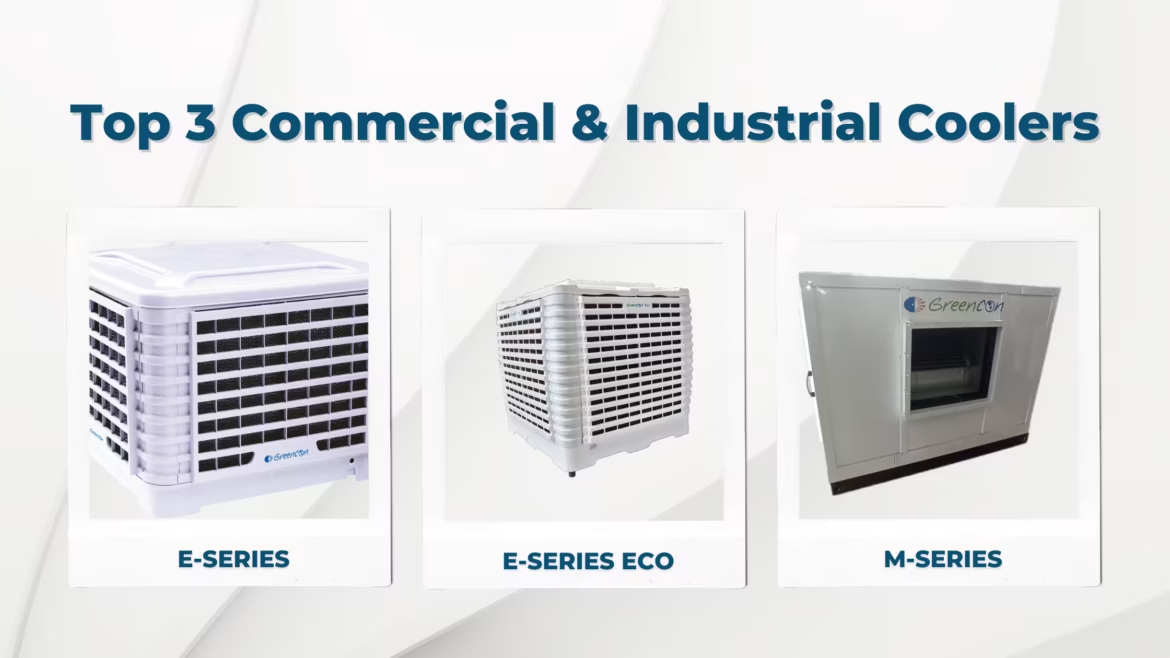
Top 3 Commercial & Industrial Coolers

by Priyanka Gupta

When it comes to cooling large commercial and industrial spaces, such as factories, warehouses, workshops, production floors, gyms, or commercial kitchens, choosing the right evaporative cooler makes all the difference. High airflow, low energy consumption, durable construction, and easy maintenance are key factors that determine the true value of any industrial cooling system.

To help businesses make the best decision, here’s a curated list of the Top 3 Commercial & Industrial Coolers trusted across India for powerful cooling, reliability, and long-term performance.

1. E-Series Evaporative Cooler

The E-Series is a premium, high-technology industrial and commercial air cooler designed to withstand harsh Indian conditions. Equipped with advanced microprocessor-based controls, it delivers intelligent and energy-efficient cooling. It can operate with or without ducting, offering flexible installation options. The E-Series model is available in two variants: Top Discharge and Bottom Discharge.

With a Wi-Fi display, the cooler can be conveniently controlled using a mobile phone. It features 50-speed settings for precise airflow adjustment, a water level sensor that detects low water levels, and an auto-drain function that can be programmed between 8 and 72 hours.
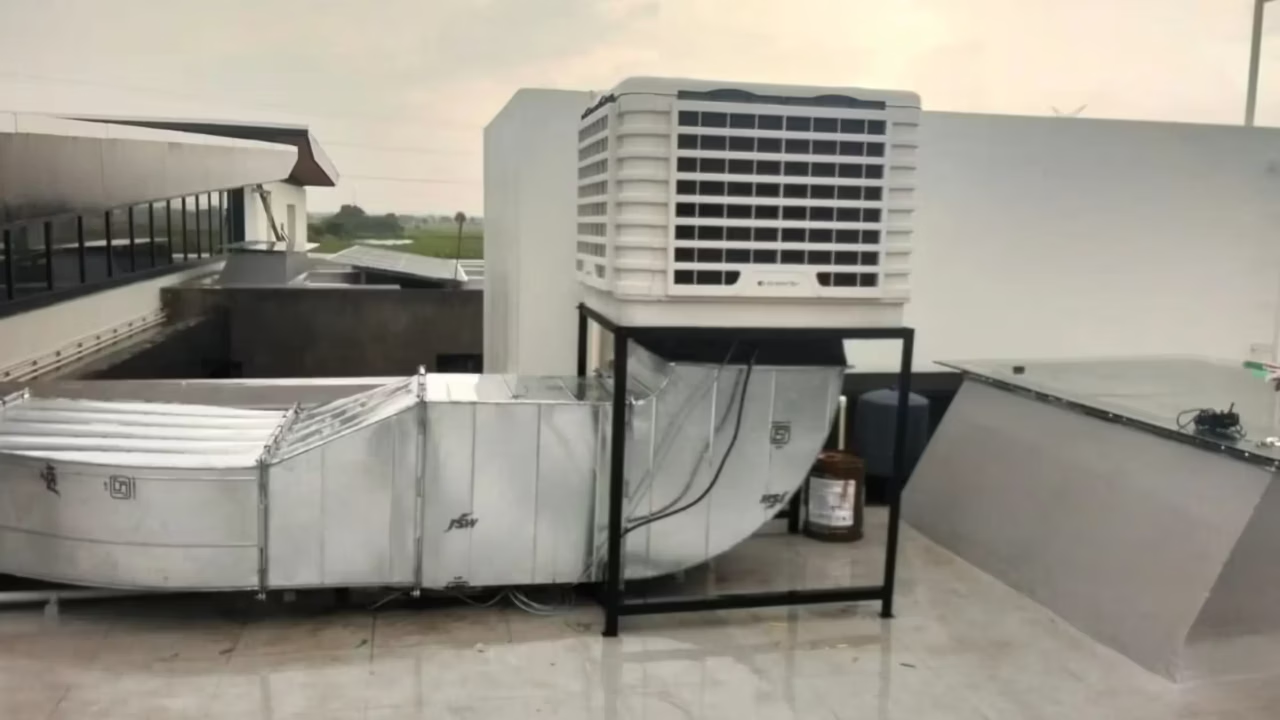
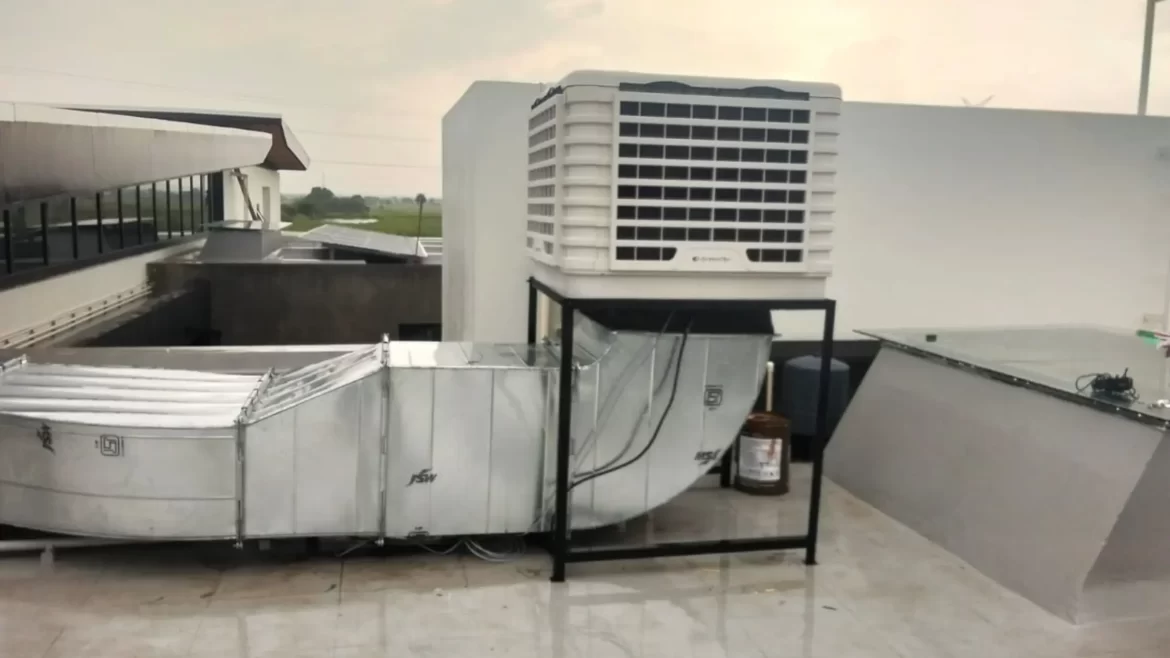
E-series installation image

E-Series Features & Specifications

1. Airflow options up to 10,000 CFM
2. Available in both single-phase and three-phase models
3. Tank capacity: 40 litres
4. Peak water consumption: approximately 20-120 litres per hour

Buy E-Series Evaporative Cooler

2. E-Series Eco Budget Cooler

The E-Series Eco is designed for users who want strong cooling performance but at a more economical price point. It maintains the same core reliability as the E-Series, but with optimized features for cost efficiency. The E-Series Eco model is available in two variants: Top Discharge and Bottom Discharge. It has an auto-drain function that can be programmed between 8 and 72 hours.
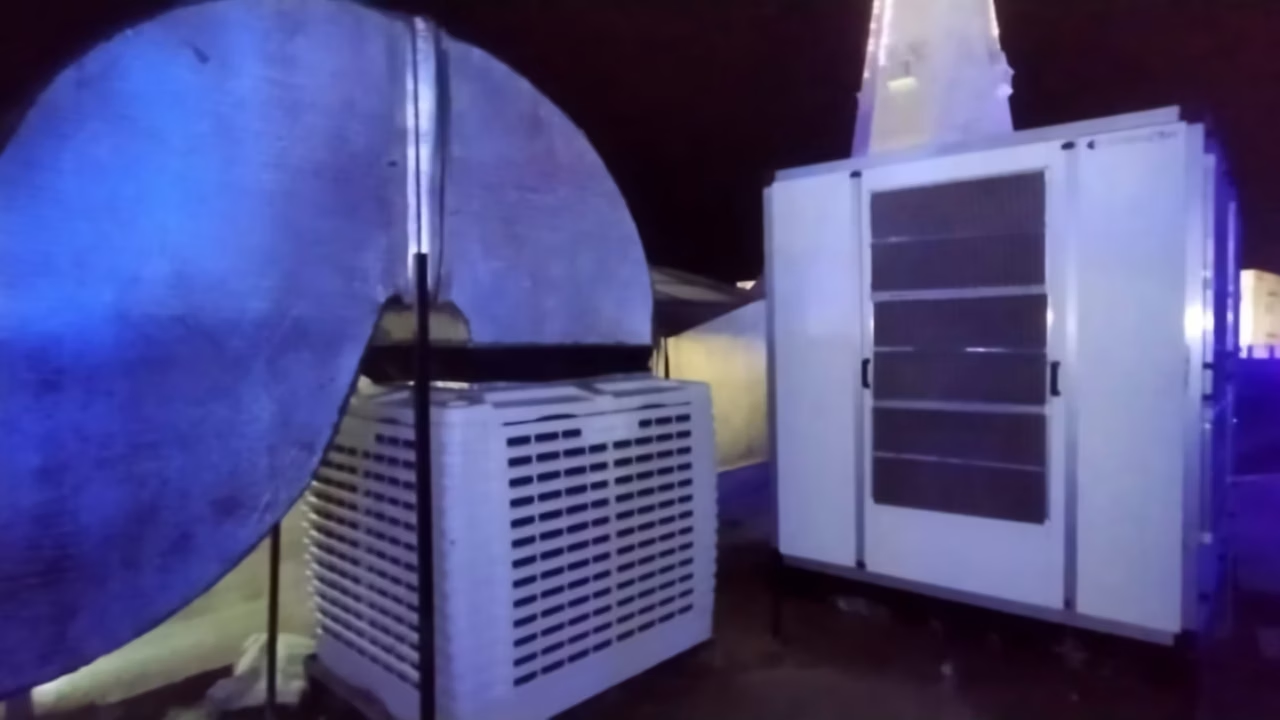
E-Series Eco Features & Specifications

1. Airflow options range from 10,000 CFM to 17,600 CFM
2. Available in both single-phase and three-phase models
3. Tank capacity: 25 – 30 litres
4. Peak water consumption: approximately 20-120 litres per hour

Buy E-Series Eco Budget Cooler

3. M-Series Duct Cooler

The M-Series is engineered for central cooling where long duct lengths and high static pressure are required. These coolers are constructed from heavy-duty galvanized steel and powder-coated for enhanced durability. They are ideal for projects requiring centralized air distribution across multiple rooms or large floor areas.
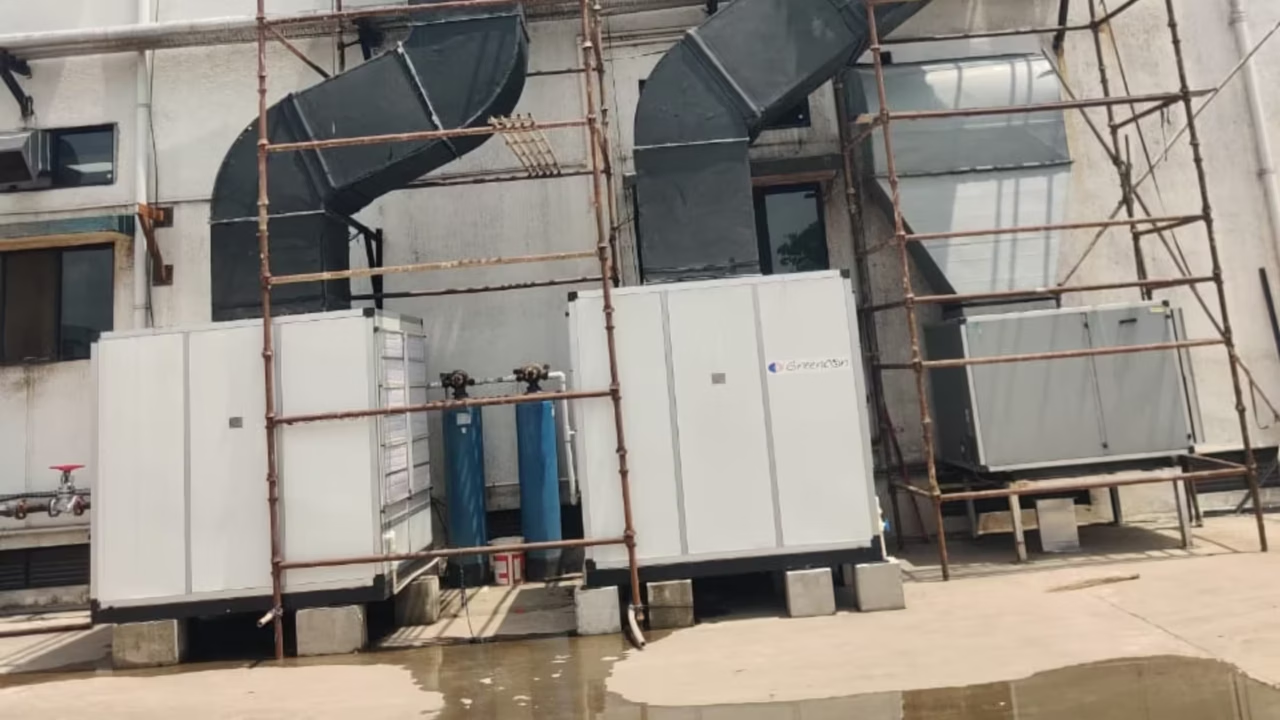
M-Series Duct Cooler Features & Specifications

1. Airflow options range from 4,000 CFM to 40,000 CFM
2. Available in both single-phase and three-phase models
3. Tank capacity: 50 – 600 litres
4. Peak water consumption: approximately 48 – 480 litres per hour
5. Fixed & Variable Auto-drain function that can be programmed between 8 and 72 hours.

Buy M-Series Duct Cooler

Checklist for Buying Commercial & Industrial Coolers

1. Evaporative coolers work best in hot, dry regions where humidity is low. They are ideal for Central and Western India (Madhya Pradesh, Rajasthan, Maharashtra), but less effective in coastal or humid zones such as Kerala, West Bengal, and Chennai.

👉 Rule of thumb: If your local humidity is consistently above 60%, consider hybrid cooling solutions.

2. Airflow capacity, measured in CFM (Cubic Feet per Minute), should be chosen according to your room size or area. The table below helps you understand how much airflow you require and which cooler suits you best.

👉 For factories, warehouses, or banquet halls, always opt for high-CFM industrial coolers.

Room SizeRecommended CFM
Small rooms (up to 250 sq. ft.)1,000–2,000 CFM
Medium spaces (250–500 sq. ft.)2,000–4,000 CFM
Large halls/industrial areas5,000–10,000+ CFM

3. In Indian cities with water scarcity, choose models with efficient water management, because water is the lifeblood of evaporative cooling. Look for features like large tank capacity, auto-drain options, and water level sensors.

4. Maintenance & Durability

1. Always choose honeycomb cooling pads, as they last longer than traditional aspen pads.
2. For construction material, prefer stainless steel for durability and plastic for affordability

5. Always ask for a demo or airflow test before purchase, and check whether the brand offers local service support to ensure hassle-free maintenance.
Get in Touch

Please share your details below and we’ll get back to you soon.

Recent Blogs

21Nov

Evaporative Cooling: India’s Answer to Beating the Heat

by Priyanka Gupta

Imagine walking into a factory in Indore on a 45 °C summer afternoon. Instead of the usual hot, suffocating air, you are welcomed by a cool, refreshing breeze. No air conditioners humming in the background, no massive power bills looming, just fresh, naturally cooled air.

That’s the magic of evaporative cooling. It is not a new idea; our ancestors used wet khus mats (vetiver grass) and earthen pots for cooling, but today, the same principle is powering modern, energy-efficient HVAC systems across India. And in hot, dry regions like Rajasthan, Gujarat, and Madhya Pradesh, it is proving to be a game-changer.

How It Works (The Simple Science)

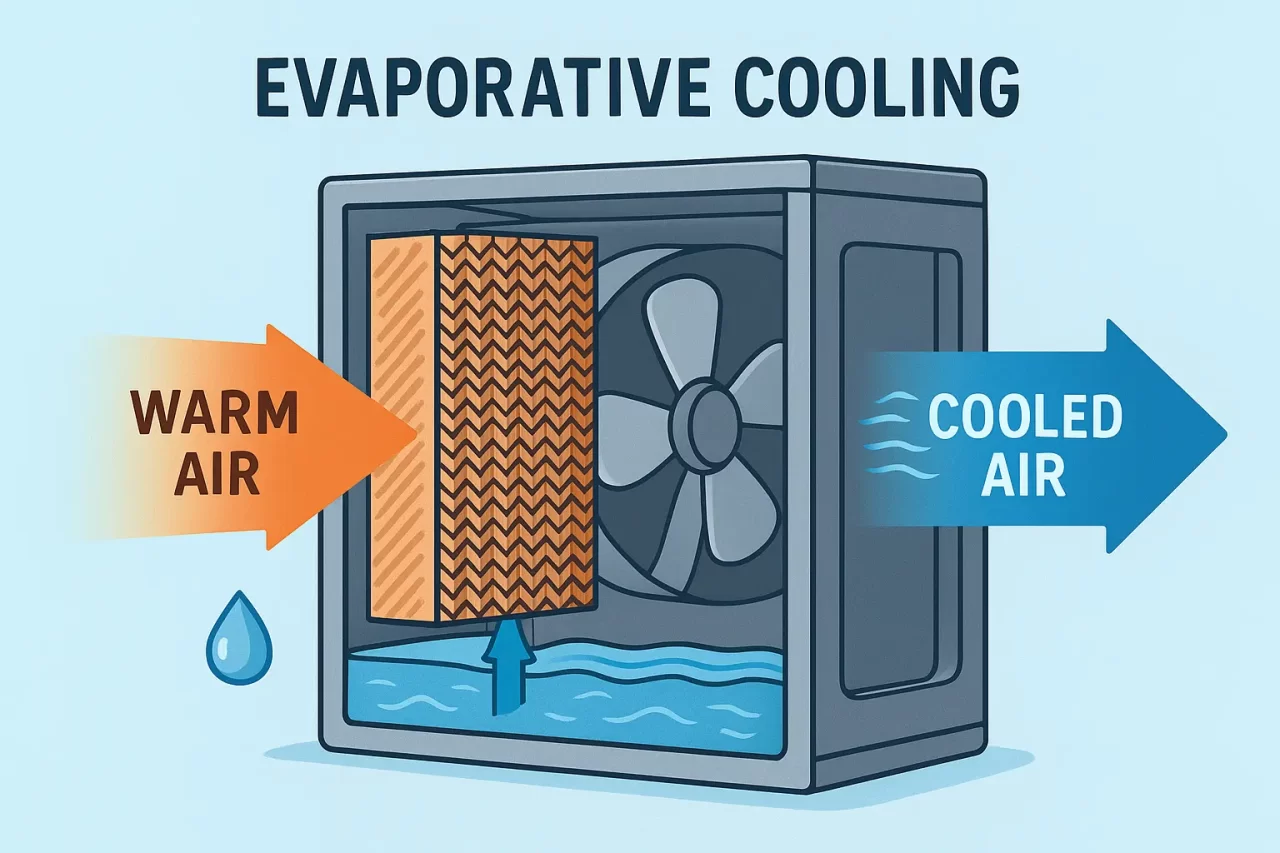
Think about how you feel when sweat evaporates from your skin; it cools you instantly. Evaporative cooling uses that exact principle.

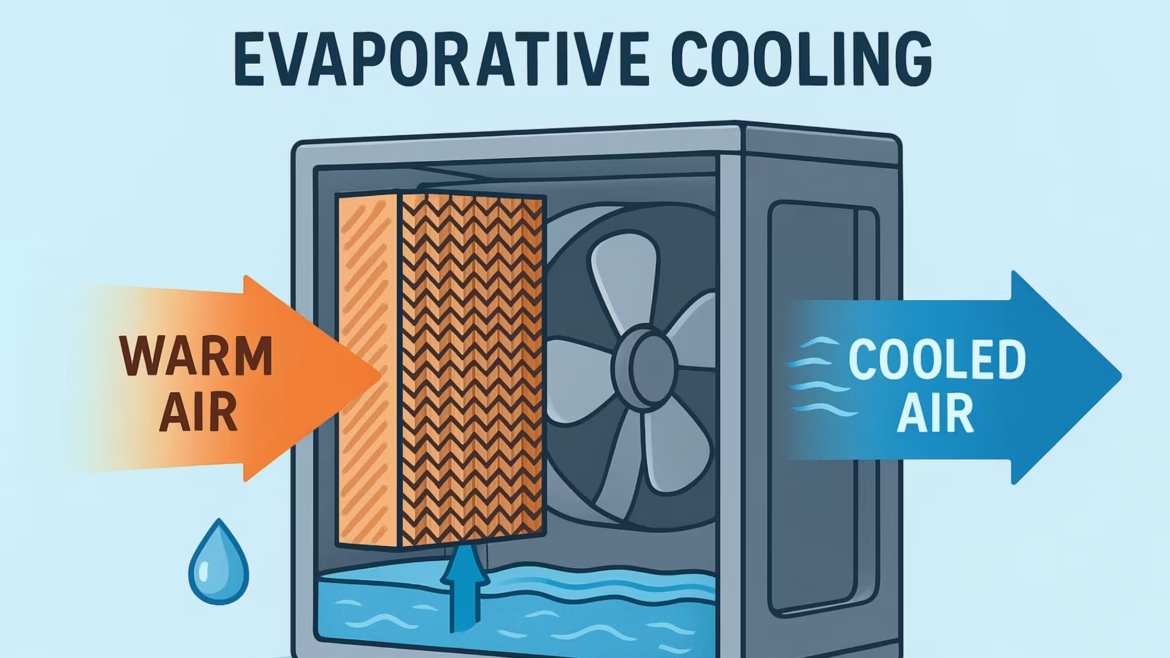
Hot outside air is pulled through water-soaked cooling pads. As the water evaporates, the air temperature drops, and a fan circulates that cool, fresh air indoors. The drier the air, the stronger the effect, making it perfect for much of India’s climate.

Why It is Perfect for Indian Climates

In cities like Jodhpur, Jaipur, Indore, and Nagpur, summers are long, hot, and dry. Here, evaporative cooling can reduce indoor temperatures by 12–20 °C, making warehouses, factories, gyms, banquet halls, auditoriums, hospitals, malls, showrooms, hotels, places of worship, schools, and homes comfortable without consuming massive amounts of electricity

See Our Case Study Videos: https://www.instagram.com/degreeday

Unlike air conditioners, which recycle the same stale air, evaporative coolers deliver 100% fresh outdoor air, a big plus for health in crowded workplaces and schools.

Benefits of Indian Businesses & Homes Love

1. Huge energy savings – Up to 80 to 90% less electricity than ACs, keeping power bills under control.
2. Lower investment – Easy to install and maintain; no complex refrigerants or compressors.
3. Eco-friendly – Just water and air—no harmful gases, no ozone damage.
4. Better indoor air quality – Fresh, filtered air improves comfort, reduces dust, and adds healthy humidity.
5. Boosts productivity – Comfortable workers mean fewer absentees and higher efficiency.

For industries like textiles in Surat, auto manufacturing in Pune, or warehouses in Delhi NCR, factories in Lucknow, these savings directly improve the bottom line.

Challenges to Keep in Mind

  • Works best in dry regions; less effective in humid states like Kerala or Bengal.
  • Needs a steady water supply, which can be a concern in drought-prone areas.
  • Requires regular cleaning of pads and tanks to prevent scaling or bacterial growth.
  • Adds some humidity, which may not suit all indoor environments.

But for much of central, western, and northern India, the benefits far outweigh the limitations.

Where It is Being Used in India

1. Factories & warehouses – Keeping workers cool at a fraction of AC costs.
2. Textile & garment units – Maintaining temperature control without damaging fabrics.
3. Agriculture & poultry farms – Creating the right environment for plants and livestock.
4. Educational institutions – Affordable comfort for schools and colleges.
5. Retail & commercial spaces – Especially in Tier-2 and Tier-3 cities, where energy costs are a concern.
6. Event venues – Large outdoor fans are common in wedding halls, pandals, and stadiums.

The Road Ahead for India

With rising electricity costs and government pushes toward energy efficiency, evaporative cooling is gaining attention as a sustainable HVAC solution. Innovations like solar-powered coolers, smart controls, and hybrid models are making the technology even more reliable for Indian conditions.

As India faces longer, harsher summers, this eco-friendly alternative to ACs will play a vital role in keeping people comfortable, cutting costs, and reducing carbon footprints.

Evaporative cooling is more than just a cost-saving option. It is a climate-smart solution designed for India’s toughest summers. Whether you are running a factory in Rajasthan, a warehouse in Madhya Pradesh, or even a school in Gujarat, this technology offers comfort, savings, and sustainability all in one package.

At Degree Day Pvt. Ltd., we design and deliver evaporative cooling solutions tailored for Indian industries, homes, and climates. If you are ready to cut electricity costs and keep cool naturally, let’s make it happen.

Recent Blogs

Get in Touch

Please share your details below and we’ll get back to you soon.

11Nov

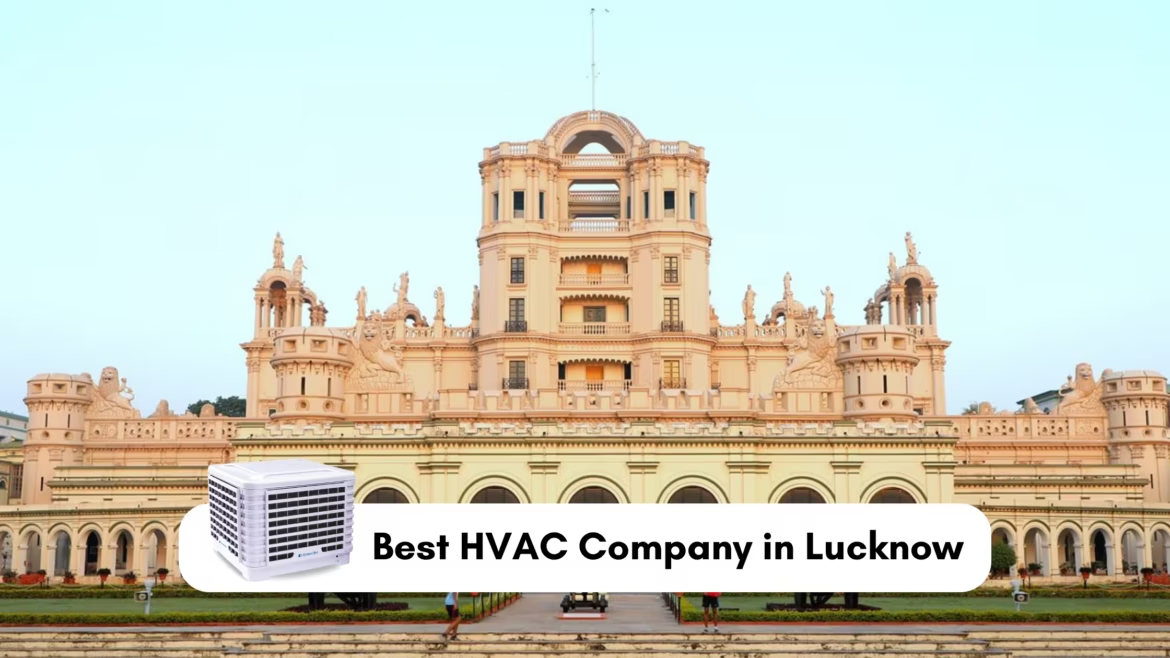
Best HVAC Company in Lucknow

by Priyanka Gupta

Lucknow has always been a city of balance, a blend of tradition and progress, of history and innovation. As the skyline continues to rise and new businesses establish themselves across the city, one thing has become clear: comfort and air quality are no longer luxuries, but essentials.

That’s where Degree Day steps in. With over 25 years of experience and ISO 9001:2015 certification, Degree Day has established itself as a trusted name in the world of HVAC design, manufacturing, and turnkey solutions across North India. Whether it’s a hospital requiring precision air control or a commercial complex demanding energy efficiency, the company has earned a reputation for delivering results that last.

Need Advice?Want Product Catalogues?


More Than Just Air Conditioning: A Complete HVAC Experience

When people hear “HVAC,” they often think of cooling or heating systems. But true comfort goes beyond temperature. It’s about air quality, circulation, humidity, and even energy management.

Degree Day specializes in turnkey HVAC solutions, which means we handle every aspect of your project from the first consultation to the final commissioning. You don’t have to coordinate with multiple vendors or stress about technical details. Our experts take care of everything:

1. Site Evaluation: Understanding Your Space, Requirements, and Energy Needs.
2. System Design: Creating tailored solutions that perfectly fit your environment.
3. Installation: Flawless execution with safety and efficiency in mind.
4. Maintenance & Support: Routine inspections and reliable after-sales service to keep systems performing at their best.

It’s a smooth, worry-free experience, the way professional climate control should be.

Why Businesses Across Lucknow Trust Degree Day

Over the years, Degree Day has earned a reputation for precision, reliability, and genuine trust. Our journey has taken us across a wide range of industries, from advanced cleanrooms and large-scale manufacturing facilities to hospitals, retail spaces, and modern corporate offices.

In Lucknow and throughout Uttar Pradesh, we offer comprehensive HVAC solutions tailored to every type of space, including basement ventilation, cleanroom environments, hospitality setups, showrooms, residential complexes, commercial buildings, and full-scale industrial projects. Whatever the need, our focus remains the same: delivering comfort, efficiency, and performance that lasts.

Here’s what sets them apart:

1. Decades of Experience: With 25+ years in the HVAC industry, their team understands every technical and environmental challenge Lucknow presents.
2. Quality Without Compromise: All projects adhere to global standards, including ISHRAE and ASHRAE guidelines.
3. Energy Efficiency First: Their systems are designed to reduce energy costs while maintaining superior performance.
4. Customized Designs: Every project is unique, and so is every Degree Day solution.
5. Transparent Pricing: No hidden costs, no surprises, just honest, value-driven service.

From design to execution, Degree Day ensures that every system not only performs but also endures.

Trusted by India’s Leading Brands

Degree Day’s portfolio in Lucknow speaks volumes. Some of the region’s most respected names rely on our HVAC systems for efficient and reliable operations, a true mark of trust and capability.

Our Clients in Lucknow Include:
Kanpur Plastic, Viraj Constructions, Birla Dharamshala (Ayodhya), Lete Hue Hanuman Mandir, Safety Shoes Manufacturing Unit, Ex-CM Residence, Delhivery Warehouse (Lucknow), Ford Car Showroom, and many more.

Smart, Sustainable, and Ready for the Future

In today’s world, efficiency and sustainability go hand in hand. Degree Day integrates smart automation and eco-friendly HVAC technologies to help clients cut energy use without compromising comfort.

Our products & Services include centralized air conditioning, UVGI-based air purification, prefabricated ducts, Mist Cooling System, Bladeless Fans, Exhaust Fans, Basement Ventilation, HVAC Design, HVAC Projects, Clean Room Solution, HEPA Air Purifiers, Air Washer, Air Handling Units, Single, Dual and Hybrid Evaporative Cooling System, and smart energy control, all engineered to ensure clean, safe, and sustainable indoor environments.

Whether it’s a high-end commercial space or an industrial setup, Degree Day’s team ensures the perfect balance between technology, performance, and environmental responsibility.

Why Local Expertise Matters

Lucknow’s climate can be unpredictable sweltering summers, humid monsoons, and chilly winters. Generic systems simply don’t cut it here. Our deep understanding of local weather patterns and building needs means their solutions are built for real conditions, not assumptions.

We don’t just install machines; we design environments where people can work, heal, and live comfortably all year round.

Building Better Air, Together

Comfort isn’t just about cooling a room; it’s about creating spaces that help people feel better, work smarter, and breathe easier. That philosophy drives everything Degree Day does.

Whether you’re planning a new project or upgrading an existing system, Degree Day is ready to design, deliver, and maintain an HVAC solution that aligns with your vision and budget.

Quick Highlights

● 25+ years of HVAC expertise
● ISO 9001:2015 Certified
● Turnkey project design & execution
● Energy-efficient and eco-friendly systems
● Trusted by India’s leading brands

Frequently Asked Questions

1. What makes Degree Day the best HVAC company in Lucknow?

With 25+ years of experience and ISO 9001:2015 certification, Degree Day delivers reliable, high-performance HVAC systems. From design to maintenance, every project is tailored for efficiency, durability, and Lucknow’s unique climate.

2. What types of HVAC solutions does Degree Day offer?

They offer complete HVAC solutions – centralized AC, air purification (UVGI + HEPA), prefabricated ducts, air washers, evaporative air coolers, air purifiers, cleanroom systems, ventilation setups, and hybrid cooling for homes, offices, and industries.

3. Does Degree Day handle end-to-end HVAC projects?

Yes. Degree Day manages turnkey projects from site evaluation and design to installation, commissioning, and maintenance—ensuring a smooth, worry-free process.

4. Why is local HVAC expertise important for Lucknow projects?

Lucknow’s hot, humid climate needs specialized systems. Degree Day’s local experience ensures efficient, weather-optimized solutions that perform year-round.

5. Which leading clients trust Degree Day’s HVAC solutions in Lucknow?

Trusted by brands like Kanpur Plastic, Viraj Constructions, Birla Dharamshala (Ayodhya), Lete Hue Hanuman Mandir, and Ford Showroom, among others.

Get in Touch

Please share your details below and we’ll get back to you soon.

25Sep

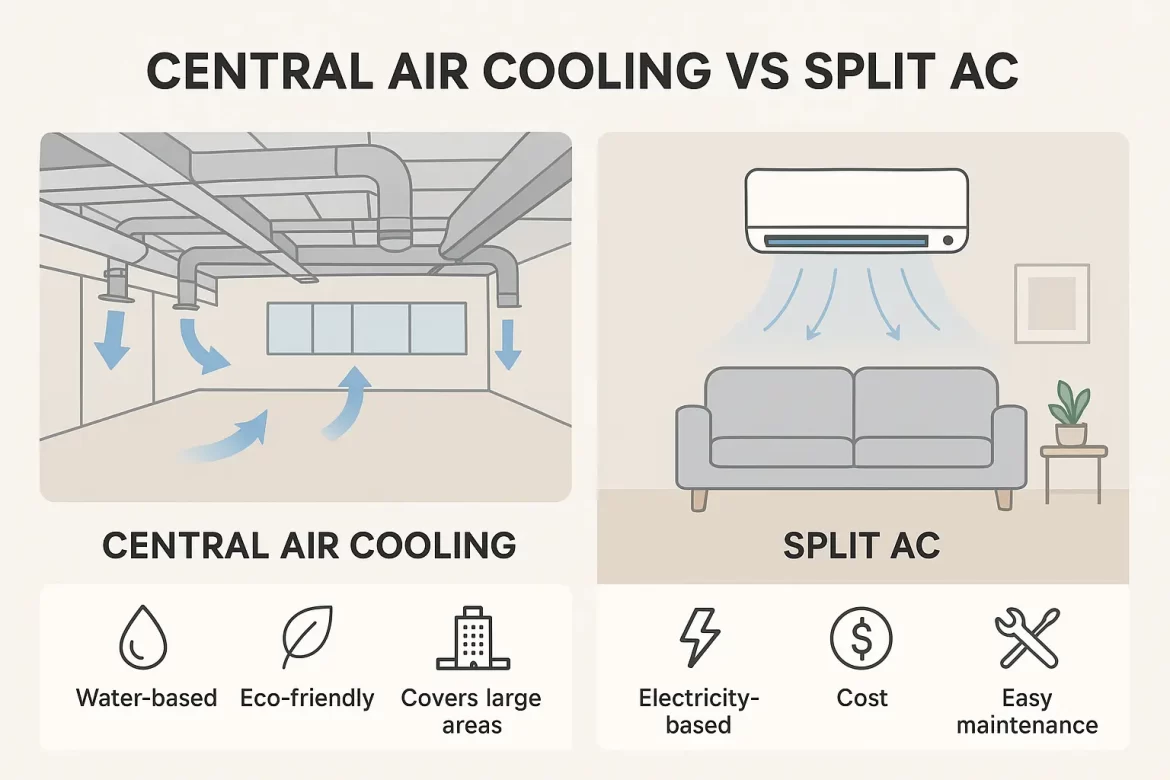
Central Air Cooling vs Split AC

by Priyanka Gupta

Central Air Cooling vs Split AC: Choosing the Right System for Large Buildings in India

If you are planning the cooling system for a large building in India, whether it is a school, factory, shopping mall, or office complex, the choice between central air cooling and Split AC is a significant one. Both systems aim to keep indoor spaces comfortable, but they differ in terms of performance, cost, and suitability for Indian climates.

Let’s break it down so you can make a smart, informed decision.

1. Coverage Area

Central Air Cooling is built for scale. It is ideal for large, open layouts like manufacturing units, auditoriums, educational campuses, and multi-storey buildings. One system can cool thousands of square feet.

Split ACs are better suited for smaller, enclosed spaces, such as cabins, classrooms, or individual offices. For a large building, you need dozens of units. In open-plan buildings, Central Air Cooling is the clear winner. For segmented layouts, Split ACs might be more practical.

2. Energy Efficiency & Running Costs

Central Air Cooling uses evaporative cooling, a technology that consumes up to 80% less electricity than conventional ACs. It is especially effective in hot and dry regions like Madhya Pradesh, Rajasthan, and parts of Delhi NCR.

Split ACs rely on compressor-based refrigeration, which is power-intensive. The more units you install, the higher your electricity bills. If you are looking to cut long-term energy costs, Central Air Cooling is far more economical.

3. Installation & Infrastructure

Central Air Cooling requires ducting, a water supply, and planning during construction or major renovation. Once installed, it integrates neatly into the building’s design.

Split ACs are easier to install individually. But in large buildings, installing 20–50+ units can clutter walls and exteriors with outdoor units not ideal for aesthetics or maintenance.

4. Air Quality & Comfort

Central Air Cooling continuously brings in fresh, filtered, and humidified air, great for maintaining healthy indoor environments, especially in dusty or dry regions.

Split ACs recirculate the same indoor air. Over time, this can lead to dryness and stale air, which is not ideal for comfort or health. For better air quality and comfort, Central Air Cooling takes the lead.

5. Maintenance

Central Air Cooling offers centralized maintenance, duct cleaning, water checks, and periodic servicing.

Split ACs require individual upkeep. Each unit needs filter cleaning, coil checks, and gas refills. In large buildings, this becomes a costly and time-consuming task.

6. Cost Consideration

Central Air Cooling involves a higher upfront investment, but its low electricity consumption and centralized maintenance make it cost-effective over time.

Split ACs may seem cheaper initially, but when scaled up, the combined cost of multiple units and high energy use adds up quickly.

7. Climate Suitability

Central Air Cooling works best in hot and dry climates, perfect for much of central and northern India.

Split ACs perform well in all climates, including humid coastal areas like Mumbai, Chennai, and Kolkata.

Quick Comparison Table

FactorCentral Air CoolingSplit AC
Coverage AreaLarge open spaces, multi-floor layoutsSmall rooms, cabins
Energy Use60–80% less powerHigh, especially with many units
Air QualityFresh, filtered, humidified airRecirculated, dry air
InstallationDucting & planned setupEasy, but messy in bulk
Operating CostVery low long-termHigh recurring bills
MaintenanceCentralizedIndividual per unit
Climate SuitabilityHot & dry regionsAll climates
AestheticsClean design, hidden ductsOutdoor units clutter the walls

Frequently Asked Questions:

1. Is Central Air Cooling cheaper than Split AC in the long run?

Yes. It consumes significantly less electricity, making it more cost-effective for large buildings over time, especially in dry regions.

2. Which system is better for large buildings in India?

For open layouts in hot, dry areas like Indore, Jaipur, or Nagpur, Central Air Cooling is ideal. For smaller rooms or humid regions, Split ACs are more suitable.

3. Does Central Air Cooling provide fresh air?

Absolutely. It pulls in fresh outdoor air, filters it, and adds humidity—unlike Split ACs, which just recirculate indoor air.

4. What is the downside of using Split ACs in large buildings?

High electricity bills and maintenance. Each unit needs separate servicing, and the outdoor units can clutter your building’s exterior.

5. Does Degree Day offer Central Air Cooling solutions in India?

Yes! Degree Day specializes in designing and delivering customized Central Air Cooling systems for commercial, industrial, and institutional buildings across India.

Choosing the right cooling system is not just about comfort; it is about saving energy, reducing costs, and improving indoor air quality. At Degree Day Pvt. Ltd., we design Central Air Cooling systems tailored for Indian conditions and large-scale applications. Whether you are planning a new project or upgrading an existing setup, our team can help you find the most efficient, sustainable, and cost-effective solution. Contact us today to explore how Degree Day can transform your building into a cooler, cleaner, and more energy-smart space.

Latest Posts

Get in Touch

Please share your details below and we’ll get back to you soon.

8Sep

Evaporative Cooling

by Priyanka Gupta

Imagine walking into a factory in Indore on a 45 °C summer afternoon. Instead of the usual hot, suffocating air, you are welcomed by a cool, refreshing breeze. No air conditioners humming in the background, no massive power bills looming, just fresh, naturally cooled air.

That’s the magic of evaporative cooling. It is not a new idea—our ancestors used wet khus mats (vetiver grass) and earthen pots for cooling but today, the same principle is powering modern, energy-efficient HVAC systems across India. And in hot, dry regions like Rajasthan, Gujarat, and Madhya Pradesh, it is proving to be a game-changer.

How It Works (The Simple Science)

Think about how you feel when sweat evaporates from your skin; it cools you instantly. Evaporative cooling uses that exact principle.

Hot outside air is pulled through water-soaked cooling pads. As the water evaporates, the air temperature drops, and a fan circulates that cool, fresh air indoors. The drier the air, the stronger the effect, making it perfect for much of India’s climate.

Why It is Perfect for Indian Climates

In cities like Jodhpur, Jaipur, Indore, and Nagpur, summers are long, hot, and dry. Here, evaporative cooling can reduce indoor temperatures by 12–20 °C, making warehouses, factories, gyms, banquet halls, auditoriums, hospitals, malls, showrooms, hotels, places of worship, schools, and homes comfortable without consuming massive amounts of electricity

See Our Case Study Videos: Degree Day (@degreeday)

Unlike air conditioners, which recycle the same stale air, evaporative coolers deliver 100% fresh outdoor air a big plus for health in crowded workplaces and schools.

Benefits of Indian Businesses & Homes Love

1. Huge energy savings – Up to 80 to 90% less electricity than ACs, keeping power bills under control.
2. Lower investment – Easy to install and maintain; no complex refrigerants or compressors.
3. Eco-friendly – Just water and air—no harmful gases, no ozone damage.
4. Better indoor air quality – Fresh, filtered air improves comfort, reduces dust, and adds healthy humidity.
5. Boosts productivity – Comfortable workers mean fewer absentees and higher efficiency.

For industries like textiles in Surat, auto manufacturing in Pune, or warehouses in Delhi NCR, and factories in Lucknow, these savings directly improve the bottom line.

Challenges to Keep in Mind

– Works best in dry regions; less effective in humid states like Kerala or Bengal.
– Needs a steady water supply, which can be a concern in drought-prone areas.
– Requires regular cleaning of pads and tanks to prevent scaling or bacterial growth.
– Adds some humidity, which may not suit all indoor environments.

But for much of central, western, and northern India, the benefits far outweigh the limitations.

Applications of Evaporative Cooling

  1. Factories & warehouses – Keeping workers cool at a fraction of AC costs.
  2. Textile & garment units – Maintaining temperature control without damaging fabrics.
  3. Agriculture & poultry farms – Creating the right environment for plants and livestock.
  4. Educational institutions – Affordable comfort for schools and colleges.
  5. Retail & commercial spaces – Especially in Tier-2 and Tier-3 cities, where energy costs are a concern.
  6. Event venues – Large outdoor fans are common in wedding halls, pandals, and stadiums.

With rising electricity costs and government pushes toward energy efficiency, evaporative cooling is gaining attention as a sustainable HVAC solution. Innovations like solar-powered coolers, smart controls, and hybrid models are making the technology even more reliable for Indian conditions.

As India faces longer, harsher summers, this eco-friendly alternative to ACs will play a vital role in keeping people comfortable, cutting costs, and reducing carbon footprints.

Evaporative cooling is more than just a cost-saving option. It is a climate-smart solution designed for India’s toughest summers. Whether you are running a factory in Rajasthan, a warehouse in Madhya Pradesh, or even a school in Gujarat, this technology offers comfort, savings, and sustainability all in one package.

At Degree Day Pvt. Ltd., we design and deliver evaporative cooling solutions tailored for Indian industries, homes, and climates. If you are ready to cut electricity costs and keep cool naturally, let’s make it happen.

Frequently Asked Questions (FAQs)

What is evaporative cooling, and how does it work?

Evaporative cooling uses water evaporation to cool hot air. Warm air passes through water-soaked pads, loses heat, and is circulated as cool, fresh air.

How is evaporative cooling different from air conditioning?

Unlike ACs, evaporative coolers don’t use compressors or refrigerants. They are energy-efficient, eco-friendly, and work best in ventilated or open spaces.

Where is evaporative cooling most effective?

It’s ideal for large, well-ventilated or semi-open spaces such as warehouses, factories, workshops, greenhouses, and livestock farms. A minimum space of 500 sq. ft. is recommended for effective performance.

How much cooling can I expect?

Depending on climate and humidity, evaporative coolers can lower the temperature by 7°C to 15°C (13°F to 27°F).

Is evaporative cooling energy-efficient?

Yes. It consumes up to 80–90% less electricity compared to traditional air conditioning systems.

Latest Posts

Get in Touch

Please share your details below and we’ll get back to you soon.