No, air purifiers cannot replace ventilation.
Air purifiers remove particles like dust, allergens, and microbes, but they do not remove carbon dioxide (CO₂) or bring in fresh oxygen. Proper ventilation is essential to maintain healthy indoor air quality.
Indoor air quality has become a serious concern in recent years as people spend more time indoors at homes, offices, schools, and commercial spaces. Pollutants like dust, allergens, smoke, odors, and even microscopic particles can build up inside, affecting comfort, health, and overall well-being.
In the middle of this growing awareness, many people assume that ventilation and air purification mean the same thing. After all, both are linked to “cleaner air,” right? Not exactly.
While both ventilation and air purification help improve indoor air quality, they work in completely different ways and solve different parts of the problem. Understanding this difference is the first step toward creating a healthier indoor environment.
What is Ventilation?
Ventilation is the process of bringing fresh outdoor air into a building while pushing out stale indoor air. Its main role is to keep the indoor environment feeling fresh and breathable by constantly replacing used air with new air.
Proper ventilation also plays an important role in controlling carbon dioxide (CO₂) levels, which can rise in crowded or closed spaces and cause discomfort, tiredness, and poor concentration. In addition, it helps remove lingering odors and excess humidity, reducing the chances of dampness, mold growth, and that heavy, stuffy feeling many people experience in poorly ventilated rooms.
We recently completed a basement ventilation project using axial fans, jet fans, CO sensors, and lift pressurization fans to maintain safe CO levels. Check out the full case study here: Instagram Link
Types of Ventilation:
1. Natural ventilation (windows, vents): Uses openings like windows and vents to allow fresh outdoor air to flow in and stale air to flow out naturally.
2. Mechanical ventilation (exhaust fans, fresh air systems, AHUs with fresh air): Uses powered systems and fans to actively bring in fresh air and remove indoor air in a controlled way.
3. Balanced ventilation systems: Supply and exhaust fans work together to bring in fresh air and remove stale air in equal amounts for stable airflow.
Best For:
➤ Improving oxygen levels: Ventilation brings a steady supply of fresh outdoor air inside, helping maintain comfortable and healthy oxygen levels.
➤ Reducing stuffiness and indoor pollutant buildup: Regular air exchange removes stale air, lingering odors, and trapped indoor pollutants before they can build up.
What is Air Purification?
Air purification is the process of cleaning the air inside a space by removing harmful contaminants, without necessarily bringing in fresh outdoor air. Instead of exchanging air, purification systems focus on treating the air that is already indoors.
Our HEPairé air purifiers are designed for this exact purpose. Equipped with certified H14 HEPA filters paired with G4 pre-filters, efficient UV lights, and ultra-low noise EC fans, HEPairé units remove airborne pollutants while consuming minimal power. Available in models AURA, PURA, and ASTRIA, they cater to residential, commercial, institutional, and hospital applications, ensuring clean, safe, and comfortable indoor air for spaces of all sizes.
This is especially useful in areas where outdoor air quality is poor or where additional filtration is needed. By continuously circulating and cleaning indoor air, HEPairé purifiers help make the air safer to breathe and more comfortable for occupants.
What Air Purifiers Remove:
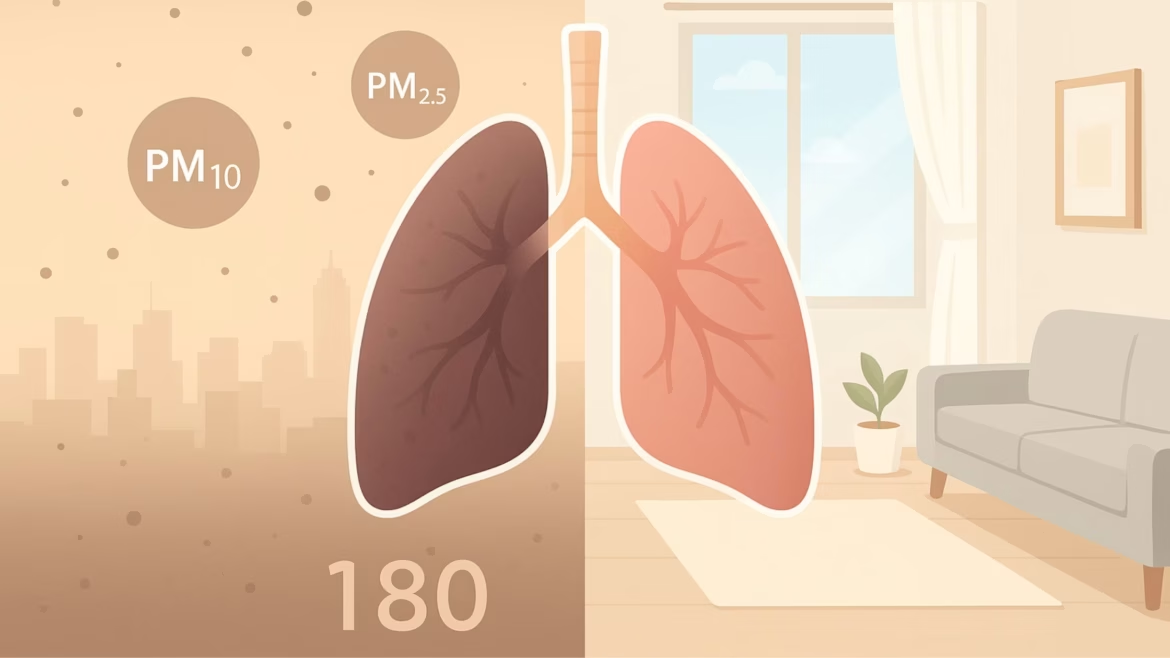
1. Dust and fine particles (PM2.5, PM10): Air purifiers capture tiny airborne particles that can enter the lungs and affect breathing.
2. Allergens (pollen, pet dander): They help reduce allergy triggers by filtering out common airborne allergens.
3. Bacteria and some viruses: Certain advanced filters and technologies can trap or deactivate harmful microorganisms in the air.
4. Smoke and odors (with carbon filters): Activated carbon filters absorb smoke, fumes, and unpleasant smells from indoor air.
Common Air Purification Technologies:
1. HEPA filters: High-efficiency filters that trap extremely fine airborne particles, including dust, allergens, and microscopic pollutants.
2. Activated carbon filters: Special filters that absorb gases, chemicals, smoke, and unpleasant odors from the air.
3. UV-C systems: Use ultraviolet light to help neutralize bacteria, viruses, and other microorganisms as air passes through.
4. Ionizers (with caution): Release charged ions to make particles settle out of the air, but should be used carefully due to possible ozone generation.
Best For:
➤ Best for areas with polluted outdoor air: Air purifiers clean the air indoors without relying on outside air, making them useful where outdoor pollution levels are high.
➤ Reducing airborne particles and microbes: They help lower the concentration of fine particles, allergens, and certain microorganisms circulating in indoor air.
Key Differences Between Ventilation and Air Purification
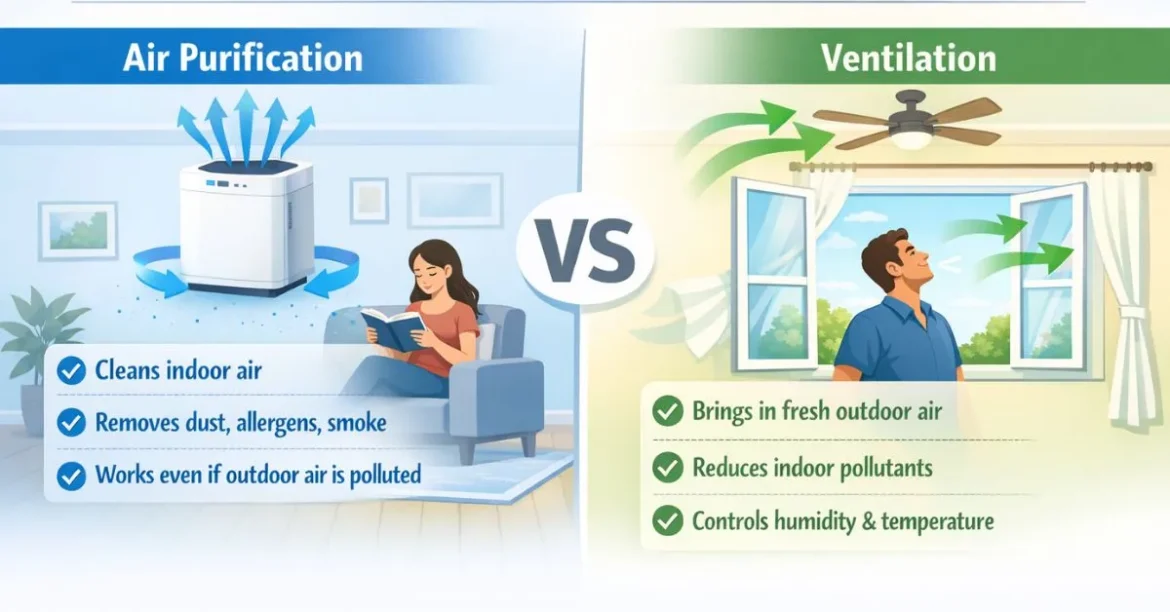
| Feature | Ventilation | Air Purification |
|---|---|---|
| Brings in fresh air | Yes | No |
| Removes indoor stale air | Yes | No |
| Filters tiny particles | Not always | Yes |
| Controls CO₂ levels | Yes | No |
| Works when outdoor air is polluted | Can bring pollution in | Yes (if filtered) |
Do Air Purifiers Remove CO₂ or Replace Ventilation?
Short answer: No. Air purifiers do not remove carbon dioxide (CO₂) and cannot replace ventilation.
Air purifiers are designed to remove particles, allergens, microbes, smoke, and odors. However, CO₂ is a gas, and standard HEPA or carbon filters do not remove CO₂ effectively.
When people occupy a room, CO₂ builds up naturally through breathing. Without proper ventilation:
➥ Oxygen levels drop
➥ CO₂ levels rise
➥ The room feels stuffy and uncomfortable
This is why air purifiers without ventilation can still result in poor indoor air quality, even if particle levels are low.
Why Ventilation Alone is Not Enough
1. Outdoor air isn’t always clean: Fresh air can carry dust, vehicle emissions, smoke, and other pollutants indoors.
2. Limited filtration of fine particles: Basic ventilation systems may not effectively remove very small particles like PM2.5.
3. Allergens can enter easily: Pollen and other outdoor allergens can be brought inside through ventilation.
4. Air quality depends on location: Buildings in urban or industrial areas may introduce more pollution than fresh air.
5. No direct air cleaning function: Ventilation mainly dilutes contaminants rather than actively removing microscopic pollutants.
Why Air Purification Alone is Not Enough
1. Doesn’t control CO₂ levels: Air purifiers clean the air but do not bring in fresh oxygen, so carbon dioxide can still build up in occupied spaces.
2. No humidity management: They do not remove excess moisture, which can lead to dampness, discomfort, or mold growth.
3. Air may still feel stale: Without fresh air circulation, indoor spaces can feel stuffy even if particles are being filtered.
4. Limited odor removal from sources: While some purifiers reduce smells, they don’t eliminate the root causes, like poor ventilation or trapped air.
5. No air exchange: Purifiers recirculate indoor air rather than replacing old air with fresh outdoor air.
The Ideal Solution: Combining Ventilation and Air Purification
When it comes to indoor air quality, the best approach is not choosing one over the other; it’s using both ventilation and air purification together.
Simply put: Healthy indoor air = Fresh air + Clean air
Ventilation brings fresh outdoor air inside and pushes stale air out. Air purification cleans the air by removing dust, allergens, and other harmful particles. When combined, they create a healthier and more comfortable indoor environment.
At Degree Day, we understand that ventilation and air purification work best together. As experts in designing smart HVAC solutions, we help you find the right balance based on your building type, occupancy, and outdoor air quality, ensuring safer, healthier, and truly comfortable indoor spaces.
Best Indoor Air Quality Solution: Purification + Ventilation
The most effective way to improve indoor air quality is by combining air purification with proper ventilation. While air purifiers clean and filter the air, ventilation ensures a continuous supply of fresh air and effective removal of CO₂ and indoor pollutants.
Explore Our Ventilation and Air Purification Solutions
Discover how Degree Day’s advanced ventilation systems and air purification solutions can help you create healthier indoor environments for residential, commercial, and industrial spaces.
Frequently Asked Questions (FAQ)
No. Air purifiers clean indoor air but do not bring in fresh air or remove CO₂. Ventilation is essential for oxygen replacement.
No. Air purifiers only recirculate and filter indoor air. Fresh air can only be introduced through ventilation systems.
They can reduce odors and particles, but without ventilation, rooms may still feel stuffy due to CO₂ buildup.
They serve different purposes. Exhaust fans remove stale air, while air purifiers clean indoor air. The best results come from using both together.
At Degree Day Pvt. Ltd., we design integrated ventilation + air purification solutions that control CO₂, particles, and comfort, especially for offices, basements, hospitals, and commercial buildings.