
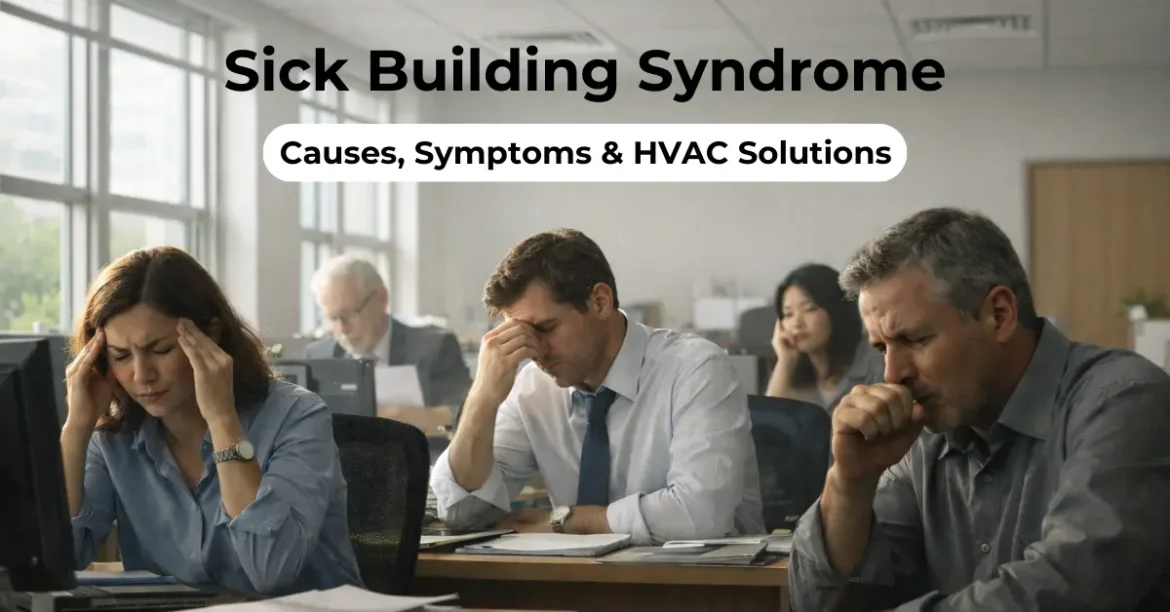
What is Sick Building Syndrome (SBS)?
Sick Building Syndrome (SBS) refers to a condition where building occupants experience health and comfort issues linked to time spent inside a building, without a clearly identifiable illness. Symptoms typically improve once the person leaves the building, indicating that the indoor environment is the root cause.
With increasing time spent indoors — in offices, factories, warehouses, and commercial spaces — maintaining proper Indoor Air Quality (IAQ) has become critical.
Read How Does HVAC System Work in Commercial Building, Industrial and Warehouses
At Degree Day, we understand that a building should enhance productivity. We help you choose the right HVAC solution to improve efficiency without compromising on health.
Common Symptoms of Sick Building Syndrome
Sick Building Syndrome symptoms may include:
❖ Frequent headaches
❖ Eye, nose, and throat irritation
❖ Dry cough
❖ Skin irritation
❖ Dizziness or nausea
❖ Fatigue
❖ Difficulty concentrating
❖ Unusual sensitivity to odors
If multiple employees experience similar symptoms within the same facility, it may indicate poor ventilation or indoor air quality issues.
Major Causes of Sick Building Syndrome
1. Poor Ventilation
Insufficient fresh air circulation is one of the primary Sick Building Syndrome causes. Modern buildings are often tightly sealed for energy efficiency, which restricts airflow and traps pollutants indoors. Read more about Air Purification v/s Ventilation
2. Indoor Air Pollutants
Common indoor pollutants include:
❖ Volatile Organic Compounds (VOCs) from paints and furniture
❖ Chemical fumes from cleaning agents
❖ Dust and particulate matter
❖ Emissions from machinery or office equipment
3. Biological Contaminants
❖ Mold and fungi
❖ Bacteria
❖ Pollen
❖ Dust mites
These contaminants thrive in poorly maintained HVAC systems or areas with excessive moisture.
4. Improper Humidity Levels
❖ Low humidity → dryness and irritation
❖ High humidity → mold growth and microbial contamination
Maintaining humidity between 40%–60% is ideal for comfort and health.
5. Poor HVAC Design or Maintenance
Clogged filters, dirty ducts, water stagnation, and improper air balancing significantly contribute to SBS.
How Degree Day Solves Sick Building Syndrome
As a trusted HVAC solutions provider, Degree Day delivers complete turnkey climate control and ventilation solutions designed to eliminate Sick Building Syndrome risks.
✔ Customized Ventilation Design: We design systems that ensure optimal fresh air exchange based on building size, occupancy, and operational needs.
✔ Industrial & Commercial HVAC Solutions: From factories to corporate offices, our systems regulate airflow, temperature, and humidity efficiently.
✔ Evaporative Cooling Systems: For large industrial spaces, energy-efficient air cooling solutions improve ventilation while maintaining cost-effectiveness.
✔ Proper Air Distribution & Balancing: Uniform airflow prevents stagnant zones where pollutants accumulate.
✔ Preventive Maintenance & Servicing: Regular system inspection ensures long-term indoor air quality and performance.
Why Indoor Air Quality Matters for Businesses
Ignoring Sick Building Syndrome can lead to:
❖ Reduced employee productivity
❖ Increased absenteeism
❖ Worker discomfort
❖ Higher operational inefficiencies
❖ Potential compliance and safety risks
Investing in proper HVAC design and ventilation is not an expense, it’s a productivity strategy.
Industrial Spaces & SBS: A Hidden Challenge
Factories and warehouses are particularly vulnerable to Sick Building Syndrome due to:
Heat-generating machinery
✔ High worker density
✔ Limited natural ventilation
✔ Dust and airborne particles
This is why HVAC systems is backbone of Industrial Infrastructure
Degree Day specializes in designing high-airflow, industrial-grade cooling and ventilation systems that improve air quality while maintaining energy efficiency.
Sick Building Syndrome is a serious indoor air quality issue that directly affects health, comfort, and business performance.
With expert HVAC planning, efficient ventilation systems, and regular maintenance, SBS can be effectively prevented.
Degree Day remains committed to delivering smart, energy-efficient, and performance-driven HVAC solutions that create healthier and more productive indoor environments.
Frequently Asked Questions (FAQs)
The primary cause of Sick Building Syndrome is poor ventilation, which allows indoor pollutants, biological contaminants, and humidity imbalance to accumulate inside the building.
Properly designed HVAC systems improve fresh air circulation, control humidity, filter pollutants, and maintain uniform airflow — significantly reducing SBS risks.
Maintaining indoor humidity between 40% and 60% helps reduce microbial growth and prevents dryness-related irritation.
Yes. Industrial spaces often face higher risks due to machinery heat, dust, limited ventilation, and large enclosed areas.
Degree Day provides customized HVAC design, industrial ventilation systems, evaporative cooling solutions, and preventive maintenance services to ensure optimal indoor air quality and occupant comfort.