
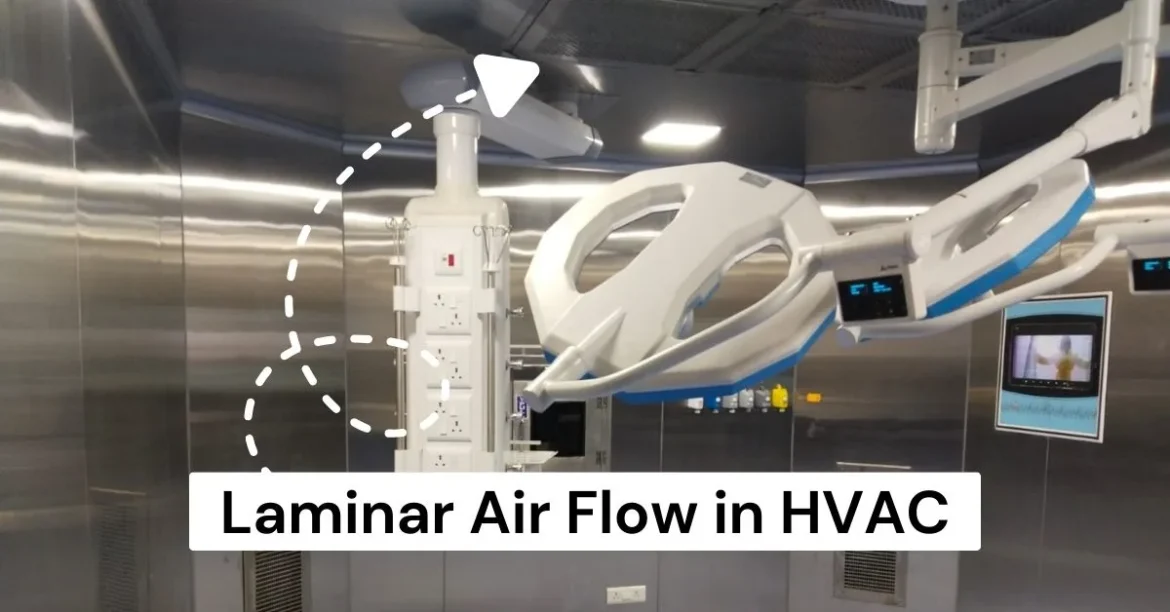
In industrial and commercial HVAC design, the airflow strategy has a direct impact on indoor air quality (IAQ), contamination control, and operational efficiency.
Two primary air distribution methods dominate modern HVAC systems:
✔ Laminar Air Flow HVAC systems
✔ Turbulent Flow HVAC systems
Understanding the difference between laminar v/s turbulent airflow in HVAC is critical when designing cleanrooms, hospitals, pharmaceutical plants, and manufacturing units.
What is Laminar Air Flow?
Laminar Air Flow (LAF) in HVAC refers to a unidirectional airflow system where air moves in parallel layers at a uniform velocity with minimal turbulence.
A laminar airflow HVAC system is specifically designed to:
✔ Control airborne contamination
✔ Maintain sterile environments
✔ Reduce particle accumulation
✔ Achieve ISO cleanroom classifications
How Laminar Airflow HVAC Works
✔ Air passes through HEPA filters or ULPA filters
✔ Filtered air flows vertically (or horizontally) in a single direction
✔ Constant velocity is maintained across the clean zone
✔ Contaminants are continuously pushed out of the critical area
If you want a deeper understanding of HEPA filtration, read our detailed blog on HEPA Filters: What they are and How they work in air purifiers
Applications of Laminar Air Flow HVAC Systems
Laminar airflow systems are used in:
➱ Cleanrooms
➱ Pharmaceutical manufacturing
➱ Operation theatres
➱ Biotechnology labs
➱ Electronics production units
You can explore our Cleanroom HVAC expertise here: Clean Room Solution
Our Recent Hospitals HVAC Projects
With extensive experience in delivering Laminar Air Flow HVAC systems for pharmaceutical environments, we have completed projects for reputed organizations including Sancheti Hospital, Gokuldas Hospital Pvt. Ltd., Greater Kailash Hospital, Narayana Hospital, M.Y. Hospital Indore, Arpit Arien Hospital, Tejankar Health Care & Medical Institute, Bombay Hospital Indore, CHL Hospital, Bhandari Hospital, Carrier Hospital, SAIMS Medical College, Dhanvantari Hospital, Khemka Hospital, Jamdar Hospital, Anand Hospital, Unique Hospital, Suyash Hospital, MVS Hospital, Mahamritunjay Hospital, Rajdadiji Hospital, Rajshree Hospital (Apollo Hospital), Synergy Hospital.
Our expertise in cleanroom HVAC design, HEPA filtration integration, pressure control systems, and contamination-free airflow solutions ensures regulatory compliance and high-performance air management across pharmaceutical manufacturing facilities.
What is Turbulent Flow in HVAC?
A Turbulent Flow HVAC system distributes air in multiple directions, allowing air to mix freely within the room.
Unlike laminar airflow, turbulent airflow HVAC systems rely on:
✔ Air dilution
✔ Mixing ventilation
✔ Standard filtration
✔ Balanced air changes per hour (ACH)
This method is commonly used in:
✔ Commercial buildings
✔ Warehouses
✔ Factories
✔ Shopping malls
✔ Offices
To understand HVAC fundamentals in commercial buildings, read: How Does an HVAC System Work in Commercial Buildings
Laminar Air Flow vs Turbulent Flow HVAC: Detailed Comparison
| Parameter | Laminar Air Flow HVAC | Turbulent Flow HVAC |
|---|---|---|
| Air Pattern | Unidirectional airflow | Mixed airflow |
| Contamination Control | Very High | Moderate |
| Filtration | HEPA / ULPA mandatory | Standard + optional HEPA |
| Energy Consumption | Higher | Moderate |
| Cost | Higher installation cost | Cost-effective |
| Suitable For | Cleanrooms, OT, Pharma | Offices, factories |
Laminar vs Turbulent Airflow: Key Technical Differences
1. Air Distribution Philosophy
✔ Laminar Air Flow HVAC → Sweeping strategy
✔ Turbulent Flow HVAC → Dilution strategy
Laminar airflow removes contaminants by pushing them away, while turbulent airflow reduces concentration through mixing.
2. Indoor Air Quality (IAQ) Impact
Laminar airflow systems provide:
✔ Predictable particle control
✔ Controlled airflow velocity
✔ Reduced infection risk
Turbulent systems provide:
✔ Thermal comfort
✔ General air circulation
✔ Cost-efficient ventilation
To understand more about indoor air quality improvement, read: Air Purification v/s Ventilation
3. Energy & Cost Comparison
Laminar airflow HVAC systems:
✔ Require higher air changes per hour (ACH)
✔ Consume more energy
✔ Need precision engineering
Turbulent airflow systems:
✔ Lower initial investment
✔ Easier retrofitting
✔ Suitable for large industrial spaces
For energy-saving strategies, read: Energy Saving Tips for Commercial HVAC Systems.
When Should You Choose Laminar Air Flow v/s Turbulent Flow HVAC?
| Choose a turbulent airflow HVAC if: | Choose turbulent airflow HVAC if: |
|---|---|
| You require ISO-classified cleanrooms | Comfort cooling is the primary goal |
| Sterility is non-negotiable | Budget optimization is important |
| Pharmaceutical or biotech production is involved | Contamination risk is moderate |
| Hospital infection control is critical | Warehouses or factories require #ventilation |
Cleanroom HVAC Design Considerations
Laminar airflow design requires:
✔ Uniform velocity distribution
✔ Proper diffuser grid design
✔ Return air wall placement
✔ Pressure differential management
To avoid design mistakes, read: Top 10 HVAC Design Mistakes
Laminar vs. Turbulent Flow in HVAC – Which is Better?
There is no universal “better” system. The right choice depends on:
✔ Application type
✔ Contamination risk level
✔ Regulatory compliance
✔ Energy budget
✔ Long-term operational goals
If contamination control is mission-critical → Laminar Air Flow HVAC
If comfort and cost-efficiency are priorities → Turbulent Flow HVAC
A professionally engineered HVAC airflow design ensures not just cooling, but controlled, intelligent air management.
For customized HVAC solutions, explore our complete product range: Greencon Products
Frequently Asked Questions (FAQs)
Laminar Air Flow HVAC systems use unidirectional airflow to push contaminants away from critical zones, making them ideal for cleanrooms and pharmaceutical units. Turbulent Flow HVAC systems mix air within the room to dilute contaminants and are commonly used in commercial and industrial buildings.
Laminar airflow HVAC systems are primarily used in pharmaceutical manufacturing, cleanrooms, hospitals, laboratories, and biotechnology facilities where contamination control is critical. Degree Day designs and executes customized laminar airflow solutions for regulated industries.
Yes, laminar airflow systems typically consume more energy because they require higher air changes per hour (ACH) and continuous HEPA filtration. However, in critical environments, the benefits of contamination control outweigh the energy costs.
Degree Day follows a systematic approach, including airflow calculation, HEPA filter integration, pressure differential management, duct design optimization, and on-site validation to ensure compliance with pharmaceutical and industrial standards.
The right choice depends on contamination risk, regulatory requirements, industry type, and budget. For sterile and high-precision manufacturing, laminar airflow HVAC is recommended. For comfort cooling and general ventilation, turbulent airflow systems are suitable. Degree Day provides consultation to help industries select the most efficient and compliant HVAC solution.